Atlanta Race Massacre, 1906
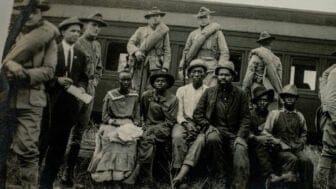
Atlanta called itself the Gate City of the New South. Black businessmen owned barbershops that catered to white elites. Black families built homes in thriving neighborhoods. Black teachers ran public schools. Black voters still went to the polls. For white supremacists, this was intolerable.
So they burned it down. They hunted people through the streets. They dragged bodies to monuments honoring Confederate generals. And then they called it a riot.
Two Newspapers, One Lie
The massacre started in the governor's race between two men who controlled Atlanta's biggest newspapers. Hoke Smith, former publisher of the Atlanta Journal, and Clark Howell, editor of the Atlanta Constitution, competed to see who could scream louder about the danger of Black voters and Black prosperity. Smith had the backing of Tom Watson, who demanded one thing: promise to strip Black Georgians of the vote.
They both delivered. They filled their papers with lies about "uppity" Black people threatening white supremacy. By summer's end, the Atlanta News and Atlanta Georgian joined the feeding frenzy, printing fabricated stories about Black men assaulting white women. When Thomas Dixon's play The Clansman opened in Atlanta - the propaganda that would become Birth of a Nation - the city became a powder keg.
But the white elite's real fear wasn't just Black success. It was the saloons on Decatur Street, where Black and white working-class people drank together and mingled. Interracial solidarity among the poor terrified Atlanta's ruling class more than Black wealth ever could.
The Acceleration
On September 22, 1906, the Atlanta News printed multiple extra editions throughout the afternoon, each reporting new fabricated assaults. Newsboys screamed the headlines on street corners. The lies built on themselves. By early evening, an estimated 10,000 white men and boys packed Five Points in downtown Atlanta, armed and screaming for blood.
Mayor James Woodward tried to calm them. He failed. When asked later about preventing the massacre, his response was chilling: "As long as the black brutes assault our white women, just so long will they be unceremoniously dealt with."
The mob destroyed Decatur Street's Black-owned businesses and saloons first - those dens of racial mixing that so offended the white establishment. Then they pulled Black passengers off streetcars and beat them to death. They hunted anyone with dark skin. Henry Welch, a lame bootblack, was shot and killed. Frank Smith, a 13-year-old Western Union messenger, jumped or was thrown from the Forsyth Street bridge onto the railroad tracks below. Bodies were dragged to the base of the Henry Grady statue.
Alonzo Herndon's Crystal Palace barbershop - the finest in the region, where the white elite got shaved - was gutted. The mob smashed its fixtures and fittings. This wasn't random. It was about putting successful Black businessmen back in their place.
Thirteen-year-old Walter White watched the mob murder a bootblack from Herndon's shop, leaving him in a pool of blood on Peachtree Street. That night changed White's life. He became executive secretary of the NAACP. Ten-year-old Margaret Mitchell also witnessed the massacre. It shaped her romanticized vision of the Old South she'd later write into Gone with the Wind.
Governor Joseph Terrell was home a few blocks away. He claimed he slept through the screams and gunshots. He didn't call in the militia until 12:20 AM Sunday - after heavy rain had already driven the mob indoors. By Sunday morning, hats and caps of victims hung from telegraph poles like trophies.
Defending Brownsville
On Monday, September 24, about 250 Black men gathered in Brownsville, a thriving middle-class community home to Clark College and Gammon Theological Seminary. They were armed and ready to defend their families and institutions. When Fulton County police learned of the meeting, they panicked and raided Brownsville with militia support.
A shootout erupted. Officer James Heard was killed. The militia arrested more than 250 Black men - including university professors. Frank Fambro, a well-known grocer, was shot dead in his own store by white men acting as deputized officers. Behind his shop lay George Wilder, a 70-year-old Civil War veteran who'd fought for the Union. Four decades after fighting to end slavery, he was lynched by the same racial hatred.
Nearly 60 Brownsville residents were sentenced to life in prison for defending their homes. Not one white person was charged with anything.
The Body Count
Official toll: 25 Black Atlantans and two whites (one a woman who died of a heart attack, the other Officer Heard). Real toll: unknown. Estimates reach 100 Black victims. Bodies disappeared into the river, unmarked graves, silence. Only in 2024 did researchers confirm identities of Marshall Carter, 13, and Stinson Ferguson, 25, from death certificates marked "riot" - the word used to hide massacre.
What They Built on Blood
The massacre worked. Thousands of Black residents fled. Atlanta's Black population dropped from 40 percent to one-third by 1910. Those who stayed were driven from Peachtree Street and downtown into contained zones. Sweet Auburn Avenue wasn't created by choice - it was economic apartheid by violence. Herndon gave up barbering and became one of the nation's first Black millionaires in insurance, serving families the white companies refused.
Hoke Smith won the governorship. He signed laws stripping Black Georgians of the vote for half a century. The white elite also used the massacre to justify statewide prohibition by 1908 - blaming Black saloons for the violence they'd manufactured themselves.
W.E.B. Du Bois, teaching at Atlanta University, armed himself with a Winchester shotgun. The massacre convinced him that Booker T. Washington's accommodationist approach had failed catastrophically. Du Bois wrote "A Litany of Atlanta" and three years later helped found the NAACP.
J. Max Barber, editor of The Voice magazine, dared to blame the massacre on white politicians and newspapers. He was given a choice: chain gang or exile. He chose exile.
The Forgetting
For decades, Atlanta buried it. The city's official historian blamed "Black riffraff." Schools ignored it. When the centennial arrived in 2006, lifelong Atlantans learned about it for the first time. It wasn't added to Georgia's curriculum until 2007.
For a century it was the "Atlanta Race Riot" - language suggesting two-sided conflict rather than one-sided slaughter. Only recently have historians reclaimed the truth: massacre.
The pattern repeats. Wilmington 1898. East St. Louis 1917. Tulsa 1921. Rosewood 1923. White mobs destroyed thriving Black communities, then newspapers called it a riot. The murderers became deputies. The victims became criminals. The erasure became history.
Atlanta still markets itself as too busy to hate. But the city's geography, its wealth gap, its segregation - all of it traces back to September 1906, when the Gate City proved that American democracy had a price, and Black lives weren't worth paying it.
Sources
- Clifford Kuhn and Gregory Mixon, "Atlanta Race Massacre of 1906," New Georgia Encyclopedia, 2022.
- David Fort Godshalk, Veiled Visions: The 1906 Atlanta Race Riot and the Reshaping of American Race Relations, University of North Carolina Press, 2005.
- Rebecca Burns, Rage in the Gate City: The Story of the 1906 Atlanta Race Riot, revised edition.
- Walter White, A Man Called White, Viking Press, 1948.
- Mark Bauerlein, Negrophobia: A Race Riot in Atlanta, 1906, Encounter Books, 2001.
- National Center for Civil and Human Rights, "Unearthing the Past: Identifying Victims of the 1906 Atlanta Race Massacre," 2024.
- Atlanta History Center, "Riot or Massacre: How 1 Word Changes Perspective," 2022.
- W.E.B. Du Bois, "A Litany of Atlanta," The Independent, October 11, 1906.
- J. Max Barber, "The Atlanta Tragedy," The Voice, October 1906.