Columbia University Protests, 1968
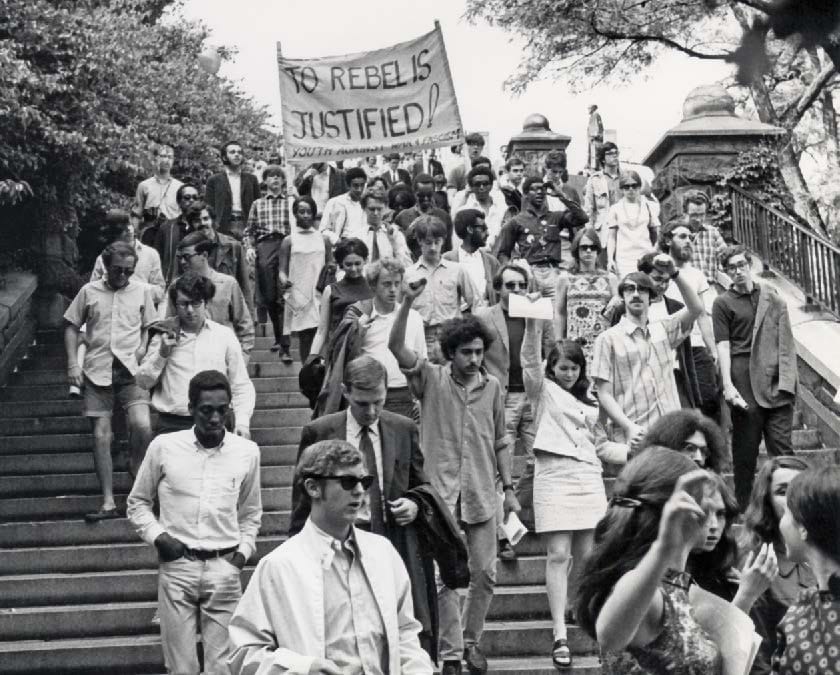
Spring 1968. America was burning. Martin Luther King Jr. had been assassinated three weeks earlier. The Tet Offensive had just shattered the lie that victory in Vietnam was near - turned out the "defeated" enemy could attack over 100 cities simultaneously and storm the U.S. embassy in Saigon. Body bags were coming home by the thousands, and the people running things kept promising the end was just around the corner. It wasn't.
At Columbia University in upper Manhattan, students discovered something that made the abstract horror of distant war suddenly, sickeningly concrete: their tuition dollars were funding it.
The War Machine on Campus
In March 1967, an SDS activist named Bob Feldman found documents buried in the International Law Library. Columbia wasn't just cheering from the sidelines. The university held institutional membership in the Institute for Defense Analyses - a Pentagon think tank developing the weapons being used to incinerate Vietnamese villages. University President Grayson Kirk sat on IDA's board. A Columbia trustee chaired it. They were building the electronic battlefield, prototyping the drones that would rain hell on peasants halfway around the world.
This wasn't some consulting gig. This was Columbia's secret lab engineering automated death. The administration tried to bury it. They placed six anti-war students on probation in March 1968 for daring to protest inside Low Library. The "IDA Six" became a rallying cry.
Gym Crow
While Columbia bankrolled the war, it was also busy colonizing Harlem. Since 1958, the university had evicted more than 7,000 residents from Columbia-controlled properties - 85 percent Black or Puerto Rican. Now they wanted to build a massive gymnasium in Morningside Park, one of Harlem's few green spaces. The plan was obscene: 88 percent of the facility reserved for Columbia's overwhelmingly white student body, 12 percent for the community whose park was being stolen. Separate entrances, naturally.
Harlem residents and Columbia's Student Afro-American Society called it what it was: "Gym Crow." The university was bringing Jim Crow architecture to New York City, with bulldozers and blueprints.
The Occupation
On April 23, 1968, about 300 students gathered at the sundial for a rally. Students for a Democratic Society and the Student Afro-American Society - white radicals and Black organizers who'd been working separately - joined forces. They marched to the gym site and tore down the construction fence. Police arrested one protester. The crowd returned to campus and stormed Hamilton Hall, trapping acting dean Henry Coleman in his office for 26 hours.
That first night, SAS asked the white SDS students to leave. The Black students had their own strategy and their own fight - stopping the gym, not debating Vietnam. They also knew that just three weeks after King's assassination, with cities still smoldering, authorities would be cautious about how they handled Black protesters. Any violence against Black students could spark the riots the city desperately wanted to avoid. SAS also refused to let their protest be defined by chaos - no destroyed files, no ransacked offices, nothing to feed the racist narrative of Black destruction that white radicals seemed happy to perform.
So the movements split. White students seized Low Library (including the president's office), then Mathematics Hall, Avery Hall, and Fayerweather Hall. For a week, nearly 1,000 protesters occupied five buildings. They organized food, medical care, and sanitation. They invited journalists, civil rights lawyers, and legislators to witness. Inside those liberated buildings, students created something else - proof that another university was possible.
The Bust
On April 30, at 2:30 AM, over 1,000 NYPD officers stormed the campus. Hamilton Hall was cleared peacefully - Black police officers led the operation, and lawyers stood ready. But in the buildings occupied by white students, it became a bloodbath. Police used nightsticks, fists, and boots. They dragged students down concrete steps, stomped on them, beat them with brass knuckles. Over 700 people were arrested. At least 132 students, four faculty members, and twelve police officers were injured. One officer, Frank Gucciardi, was permanently disabled when a student jumped from a second-story window onto him.
The brutality continued the next day as students fought back with sticks against armored cops on horseback who chased them down Broadway, clubbing them as they ran.
Three weeks later, students occupied Hamilton Hall again to protest the suspensions of strike leaders. On May 22, police raided campus a second time. Another 177 arrests. More beatings. During that second occupation, an SDS leader named J.J. Jacobs deliberately burned ten years of research belonging to Professor Orest Ranum - a young scholar sympathetic to the protesters. The man's entire book manuscript, destroyed. It was the kind of senseless, self-defeating violence that would soon consume the movement.
What They Won (and Lost)
The students won. Columbia severed ties with the Institute for Defense Analyses. The gym was scrapped (they built a fitness center under campus instead, where it belonged). A University Senate was created, giving students and faculty actual voice in governance. Black Studies programs were established. Admissions and financial aid policies changed.
But victory came at a cost the movement couldn't yet see. Mark Rudd, the 21-year-old SDS leader who'd screamed "Up against the wall, motherfucker" at administrators, would soon help found the Weather Underground. The Columbia uprising "fed a more extreme tendency," as Rudd later admitted - a descent into the delusional fantasy of armed revolution that would close down SDS at the height of the war and send activists underground to accomplish nothing but their own irrelevance.
Columbia President Grayson Kirk resigned that August. His career was over. Acting dean Coleman was fine. The cops who cracked skulls faced no consequences. Mark Rudd eventually turned himself in after seven years as a fugitive; all charges were dropped due to government illegalities. He's now a math teacher in Albuquerque, still organizing, still believing another world is possible.
The lesson wasn't that protest doesn't work. The lesson was that it does - when it's strategic, when it builds power, when it refuses to let rage devolve into self-destruction. Columbia 1968 showed that students could force an institution to reckon with its complicity in war and racism. It also showed how quickly moral clarity can curdle into sectarian violence when movements lose sight of the people they're supposed to serve.
The protesters were right. The war was genocide. The gym was racist. The university was guilty. They made Columbia admit it and forced real change. The occupation built coalitions between white and Black students, made concrete demands, and had community backing. It showed that strategic, disciplined protest could force powerful institutions to change course.
Sources
- Stefan M. Bradley, Harlem vs. Columbia University: Black Student Power in the Late 1960s (2009)
- Mark Rudd, Underground: My Life with SDS and the Weathermen (2009)
- Columbia University Libraries Online Exhibitions, "1968: Columbia in Crisis"
- Cox Commission, Crisis at Columbia: Report of the Fact-Finding Commission (1968)
- Democracy Now!, "Columbia 1968: Students, Faculty Reflect on Protests 50 Years Later" (April 2018)
- Tom Hayden, Reunion: A Memoir (1988)
- Nancy Biberman interview, Vanity Fair (2018)