Detroit Uprising, 1967
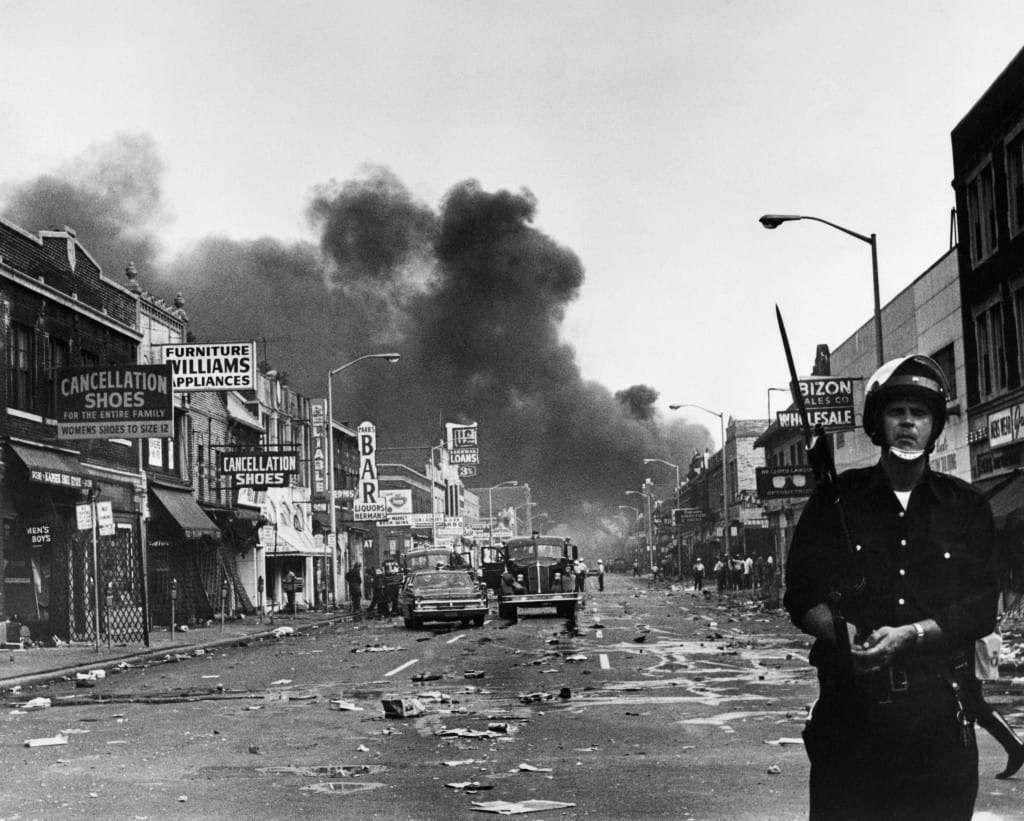
A four-year-old girl shot dead by a National Guard machine gun because someone lit a cigarette. Three teenagers executed by police in a motel room. Forty-three dead in five days. Most of them Black. Most of them killed by cops and soldiers sent to "restore order."
Detroit in July 1967 was an uprising - and a massacre.
Detroit wasn't an accident. It was inevitable.
How to Build a War Zone
By 1967, Detroit was choking on its own contradictions. The auto industry had built an empire on the backs of Black workers who'd migrated north for jobs and a shot at something better. But "better" came with conditions. Black families were redlined into neighborhoods like Virginia Park and Black Bottom, crammed into subdivided apartments while white families fled to the suburbs. Urban renewal programs bulldozed thriving Black communities to make way for freeways that carved the city into pieces.
The east side alone lost over 70,000 jobs in the decade after World War II. Deindustrialization gutted the city while white flight drained the tax base. What stayed behind was poverty, crumbling housing, and a police force that treated Black neighborhoods like occupied territory.
The Detroit Police Department was 93% white in a city that was 30% Black. Officers routinely stopped, searched, and brutalized Black residents. They called men "boys" and women "honey" while writing up anyone who didn't have proper ID. A special vice unit called the Big Four - four white cops in unmarked cars - terrorized the west side, beating people for sport and getting away with it.
Mayor Jerome Cavanagh talked about progress. He praised the city's handling of race relations. Black residents knew better. In surveys taken after the uprising, they listed police brutality as the number one cause. Not unemployment. Not housing. Police violence.
The Spark
Early Sunday morning, July 23, 1967, Detroit police raided an unlicensed after-hours bar - what locals called a "blind pig" - at the corner of 12th Street (now Rosa Parks Boulevard) and Clairmount. They expected a handful of drinkers. Instead, they found 82 people celebrating the return of two Black veterans from Vietnam.
It took hours to transport everyone to the precinct. By the time the last person was loaded into the paddy wagon, a crowd had gathered in the summer heat. Someone threw a bottle. A window shattered. Then another. By dawn, 12th Street was on fire.
The uprising spread fast. Fires, looting, and confrontations with police erupted across the city. Black-owned businesses burned alongside white-owned ones. The message wasn't about property - it was about rage. Rage at being treated like criminals in your own neighborhood. Rage at watching jobs disappear while the police stayed. Rage at a system that built highways through your community but wouldn't fix the schools.
By Monday, the National Guard rolled in with tanks and machine guns. By Tuesday, President Lyndon Johnson sent in the 82nd and 101st Airborne. American paratroopers, fresh from the jungles of Vietnam, now patrolling American streets with orders to shoot American citizens.
The Body Count
The official death toll was 43. That number hides more than it reveals.
Tanya Blanding, four years old, was shot and killed by a National Guard .50-caliber machine gun. A guardsman saw a cigarette lighter flame in a window and opened fire. She was huddled in her living room.
Julius Dorsey, a 55-year-old security guard, was shot by a guardsman while protecting a fruit market. It was called an accident.
Roy Banks, 46 and deaf, was killed walking to a bus stop to go to work. Guardsmen claimed he'd been looting.
William Dalton, 19, was shot by police and then, according to witnesses, taken into an alley and goaded into running so they could kill him.
Helen Hall, a 51-year-old white woman from Connecticut, was shot through the window of her motel room. She'd opened the curtains. A guardsman mistook her for a sniper.
Jerome Olshove was the only Detroit police officer to die. He was killed accidentally by another cop's shotgun during a struggle with a looter. His death sent shockwaves through the department. Hours later, police would storm the Algiers Motel.
The Algiers Motel Massacre
On the third night, July 25, someone at the Algiers Motel fired a starter pistol loaded with blanks out a window - a stupid prank. The National Guard thought they were under sniper attack. They called Detroit police.
What happened next wasn't law enforcement. It was murder.
Detroit police, state troopers, and guardsmen stormed the motel annex. They rounded up everyone inside - seven young Black men and two white women - and lined them against a wall. Then they began what one officer later called "the death game." They took people into rooms one by one, beat them, fired shots into the walls and floors, and told the others they'd been executed.
By morning, three Black teenagers were dead. Carl Cooper, 17. Aubrey Pollard, 19. Fred Temple, 18. All three were shot at close range with shotguns. No weapons were found. No sniper existed.
Cooper was likely killed the moment police burst in. Temple asked to go back to his room to get his shoes. He never came out. Pollard was the last to die, killed during the interrogation game after police tried to force confessions that didn't exist.
The survivors were beaten, terrorized, and told to leave and never look back. The two white women were arrested for prostitution. Lee Forsythe watched his best friends die and has lived with it for 57 years.
The officers didn't report the deaths. The next day, the motel's security guard found the bodies and called the morgue.
The Trials That Weren't
Three Detroit police officers - Ronald August, Robert Paille, and David Senak - and a private security guard were charged. August admitted killing Pollard but claimed self-defense. Paille's statements implicating himself were thrown out because detectives forgot to read him his Miranda rights. The charges were dropped.
All three officers were tried in all-white juries outside Detroit. All were acquitted. No one was ever convicted. No one faced justice.
The Detroit Police Department rehired August and Senak in 1971. They refused to rehire Paille - not because he participated in the murders, but because he'd lied in his initial report.
The Aftermath
By the time federal troops restored order on July 28, Detroit was unrecognizable. Over 1,400 buildings had been burned. More than 7,200 people were arrested. Entire blocks were reduced to ash and rubble.
The Kerner Commission, appointed by President Johnson to investigate the wave of uprisings that summer, delivered its verdict in 1968: "Our nation is moving toward two societies, one Black, one white - separate and unequal." The report blamed white racism, police brutality, unemployment, and housing segregation.
America ignored it.
White flight from Detroit doubled in 1967, then doubled again. The tax base collapsed. Jobs vanished. The neighborhoods that burned were never rebuilt. In 2013, Detroit became the largest American city ever to file for bankruptcy.
Detroit's poverty rate today is double what it was in 1967. The city still struggles with segregation, inadequate housing, the lowest school test scores in the nation, and a legacy of distrust between police and the Black community that trauma like the Algiers Motel ensures will never fully heal.
In 2024 - 57 years later - a historical marker was finally placed at the site of the Algiers Motel. The building itself was demolished in the 1970s, erased as if removing the structure could erase the crime. Survivors and family members gathered to remember Carl Cooper, Fred Temple, and Aubrey Pollard. No governor has ever apologized. No official has ever admitted the state executed three teenagers and called it an investigation.
The lesson of Detroit isn't complicated. When you build a system that treats people like enemies, when you let police brutality go unchecked, when you abandon communities economically and then blame them for their own suffering, eventually people burn it down. And when they do, the ones in power call it a riot, send in the troops, and kill more people to prove a point about order.
Detroit was an uprising. It was also a massacre. And America has spent half a century pretending it was something else.
Sources
- Sidney Fine, Violence in the Model City: The Cavanagh Administration, Race Relations, and the Detroit Riot of 1967 (1989)
- John Hersey, The Algiers Motel Incident (1968)
- Detroit Historical Society, "Uprising of 1967"
- Heather Ann Thompson, Whose Detroit?: Politics, Labor, and Race in a Modern American City (2001)
- Report of the National Advisory Commission on Civil Disorders (Kerner Commission Report, 1968)
- Detroit Free Press, "The 43 Who Died," September 3, 1967
- Detroit Under Fire: Police Violence, Crime Politics, and the Struggle for Racial Justice in the Civil Rights Era, University of Michigan HistoryLabs