Oakland General Strike, December 1946
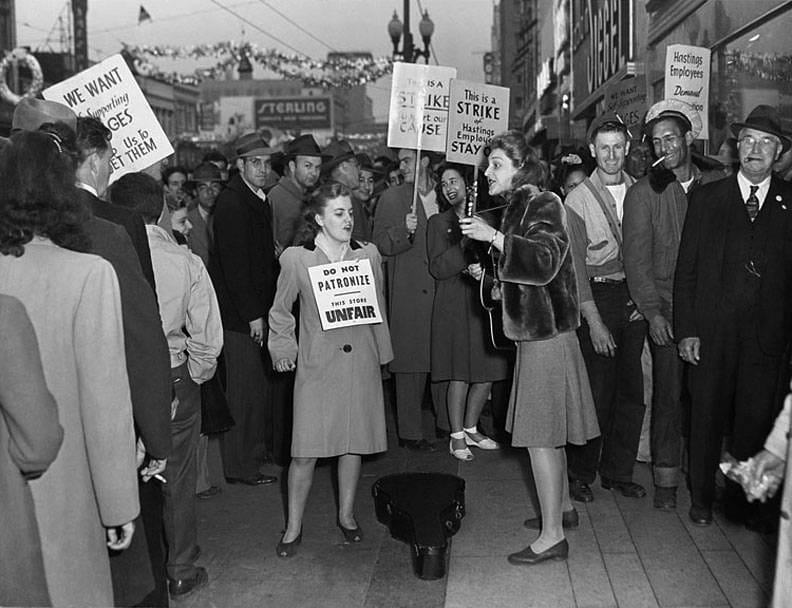
Life for Oakland’s Department Store Women
Oakland, 1947. The war was over, but peace hadn’t brought security. Prices shot up, veterans came home hungry for jobs, and the women who had kept the city running were shoved into low paid jobs with no power. At Kahn’s and Hastings the young clerks, often in their teens or twenties, were treated like disposable parts. They worked for pennies, hours changed on a whim, pay docked without reason. If the boss didn’t feel like putting you on the floor, you sat in the basement “ready room” for hours without a dime. You were at his mercy. That meant harassment, groping, even assault, with no one to turn to. That was life for department store women and girls in Oakland in 1947. And they were done with it.
The Strike Begins
By late 1946, they walked out. The clerks demanded union wages and a little dignity. The employers, lined up behind the Retail Merchants Association, said no. They brought in scabs and the cops were more than willing to help. Police escorted trucks through the women’s picket lines and cracked down on anyone who stood in the way.
The Spark
On December 3, 1946, another convoy rolled in. This time Newton Selvidge, a Key System streetcar driver, stopped his car, stepped into the street, and tried to block them. An Oakland cop on a three-wheeler ran him down and left him badly hurt, though he survived. Word shot through downtown. Streetcar workers walked off. Teamsters quickly joined, refusing to deliver goods to the struck stores. Shoppers joined them. The city started to shut down.
The Strike Spreads
By nightfall Oakland was paralyzed. Within 24 hours a hundred thousand workers had walked out. Only groceries and pharmacies stayed open. Bars poured beer only, jukeboxes were dragged onto sidewalks, and couples danced in the streets. Veterans drilled and marched on City Hall and the anti-union Oakland Tribune. This wasn’t a careful plan from the union halls. It was workers finally waking up to the abuse, and to the lengths their own taxpayer funded government would go to protect the bosses.
The Outcome
After 54 hours the national AFL big shots swooped in and called it off. City leaders promised they wouldn’t use the police as scab escorts again, but the women clerks still had months of fighting ahead before they finally won a contract. The strike left a mark. It made the Teamsters a force in Oakland, and it showed every boss in town that even retail clerks could bring the city to its knees. But it also fed a backlash. Business leaders and the Oakland Tribune screamed about “labor lawlessness,” and within months Congress passed the Taft-Hartley Act, clipping the wings of solidarity strikes across the country. The Oakland General Strike started with department store women demanding dignity and refusing to be pushed around, and it ended by showing both the power of working people and the fear that power created in those who ruled.
Sources
- FoundSF, “Oakland 1946 General Strike”
- Socialist Alternative, “The 1946 Oakland General Strike”
- Harvey Schwartz, Solidarity Stories: An Oral History of the ILWU (2009)
- David Selvin, Sky Full of Storm: A Chronicle of the 1946 Oakland General Strike (1947)
- AFL-CIO, historical summaries of postwar strike wave