Elaine Massacre, 1919
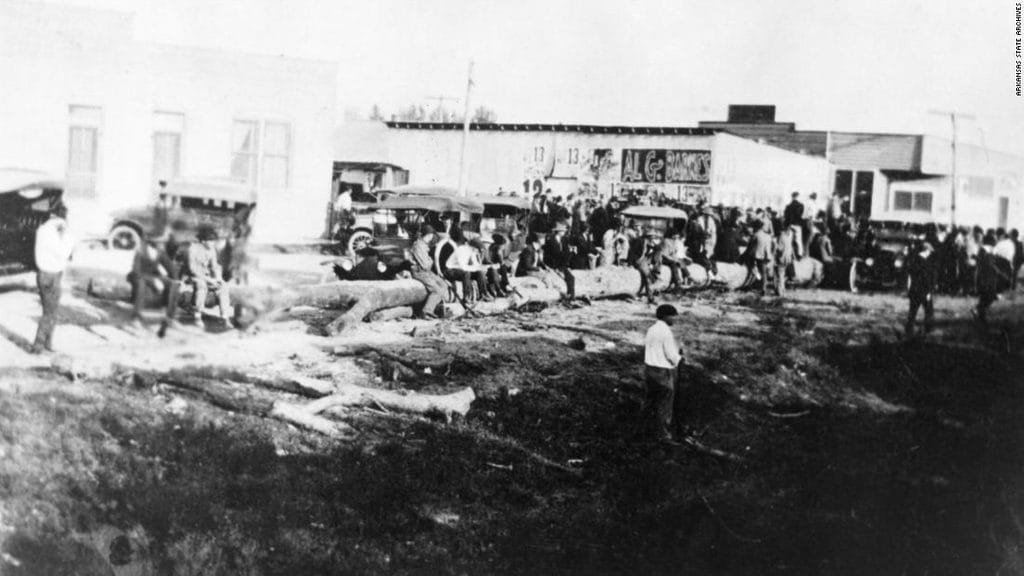
Black sharecroppers in Arkansas organized a union to demand fair payment for their cotton. White mobs responded by hunting them through the woods for days, killing hundreds. Federal troops joined in. The survivors were tortured, tried by all-white juries, and sentenced to death. Not one white person faced charges. When you hear "labor history," this is what they're talking about - organizing got you massacred, and then they blamed you for it.
Red Summer
The year 1919 was a killing season. Over three dozen American cities exploded in white-on-Black violence. In Washington, D.C., white mobs hunted Black people for four days. In Chicago, a Black teenager drifted past an invisible beach line and got stoned to death - 38 people died in the riots that followed. Over 97 recorded lynchings nationwide. The death toll in Elaine, Arkansas, dwarfed them all.
The reasons were obvious. Black WWI veterans came home unwilling to accept Jim Crow after fighting for democracy abroad. The Great Migration brought a million Black people north for factory jobs, and white workers saw competition. The Red Scare gave everyone cover - Attorney General A. Mitchell Palmer was raiding union halls and deporting immigrants, screaming about Bolsheviks and anarchists plotting revolution. Black workers organizing for better pay? That wasn't labor activism. That was insurrection. At least, that's what they called it after the killing started.
The Sharecropper Trap
Phillips County, Arkansas. Mississippi Delta cotton country. Three-quarters Black, doing the brutal work while white landowners controlled the money. The sharecropping system was peonage with accounting. Landowners sold cotton at market rates but paid pennies, charged inflated prices at company stores, never showed workers the books. Can't verify what you're owed, can't leave until the debt's paid, and the debt never gets paid. Slavery with extra steps.
Robert L. Hill, a Black sharecropper and WWI vet, wasn't having it. In 1918, he founded the Progressive Farmers and Household Union of America. By 1919, hundreds had joined. They hired Ulysses S. Bratton, a white Little Rock attorney, to sue for fair settlements. White planters panicked. Black people with lawyers demanding money they'd actually earned? Unacceptable.
The Shooting
September 30, 1919. About 100 Black sharecroppers met at a church in Hoop Spur, outside Elaine. They posted armed guards because they knew what happened to Black people who organized. Around 11 PM, deputy sheriff Charles Pratt and special agent W.A. Adkins rolled up. Official story: car trouble. Real story: breaking up the meeting. Shooting started. Adkins died. Pratt got wounded.
One dead white man was all it took.
The Massacre
White mobs formed by morning - 600 to 1,000 men from Arkansas, Mississippi, Tennessee. They hunted Black people for days. Shot them in fields, dragged them from homes, chased them into swamps. The Memphis Press reported whites shooting corpses, dragging bodies behind cars, taking souvenirs. Standard lynching procedure, scaled up.
Four Black brothers - Dr. David Augustine Elihue Johnston, Dr. Louis Harrison Johnston, Gibson Allen Johnston, and Leroy Johnston (a WWI vet who'd spent nine months recovering from war wounds) - were returning from a hunting trip. Nothing to do with the union. Didn't matter. October 1, they were stopped, arrested for "distributing ammunition," chained together, and shot dead. Bodies thrown in the road.
Eyewitnesses later testified to seeing "several hundred" Black people killed. The real number's unknown. Estimates run from 100 to over 200. Five white men died, mostly caught in crossfire or shot by their own side.
The Lie
Governor Charles Hillman Brough called in federal troops October 2. The troops didn't stop the killing - they rounded up survivors. Hundreds herded into stockades, beaten, tortured with electric shocks until they testified against each other. Those who cooperated or agreed to work without pay walked. The rest got charged.
Then came the cover story: the sharecroppers were planning an insurrection. Going to massacre white people. The Arkansas Gazette ran with "zone of negro insurrection." The New York Times: "Planned Massacre of Whites Today." Complete fabrication, perfect timing. In the middle of the Red Scare, with Palmer screaming about radicals and Bolsheviks, of course Black people organizing were really plotting genocide.
The state indicted 122 Black people. Charged 73 with murder. Sentenced 12 to death. Not one white person was arrested for days of hunting and killing.
Scipio Jones
The Elaine 12: Albert Giles, Alfred Banks, Ed Coleman, Joe Fox, Paul Hall, Ed Hicks, Frank Hicks, Joe Knox, John Martin, Frank Moore, Ed Ware, William Wordlaw. Their trials were theater. All-white juries, sham defenses, armed mobs outside the courthouse, deliberations lasting minutes. Death sentences all around.
Scipio Africanus Jones, born enslaved in 1863, had become one of Arkansas's top Black attorneys. Little Rock's Black community hired him in November 1919. When his co-counsel died suddenly, Jones took over. Years of appeals. Constant death threats. Moving locations every night. He kept fighting.
1923: The Supreme Court ruled in Moore v. Dempsey that mob-dominated trials violated due process. First time federal courts could review state trials under the Fourteenth Amendment. By January 1925, all 12 men walked free. Jones saved them and changed American law in the process.
What Justice Looked Like
Zero white people charged. Not the mob members. Not the federal troops. Not the officials who tortured confessions. Not Governor Brough who orchestrated the cover-up. They all went home.
The Klan rose in Arkansas in 1921, strongest in Black-majority areas. The terror continued. Writer Richard Wright grew up there. He asked his mother why Black people didn't fight back. "The fear that was in her made her slap me into silence."
Talking about Elaine stayed taboo for decades. A 2000 conference ended without resolution - white residents still claiming the union planned violence, Black residents knowing better. The 2019 memorial dedication? Someone torched the Elaine Legacy Center before it opened. The peace tree planted for victims got chopped down at night.
This is what organizing looked like in 1919: Black sharecroppers demand fair pay, the state massacres hundreds, blames them for plotting insurrection, prosecutes the survivors, and calls it justice. The killers faced nothing. History buried the story. And America learned that the real crime wasn't the massacre - it was Black people forgetting their place.
Sources
- Guy Lancaster, ed., The Elaine Massacre and Arkansas: A Century of Atrocity and Resistance, 1819-1919 (2018)
- Grif Stockley, Brian K. Mitchell, and Guy Lancaster, Blood in Their Eyes: The Elaine Massacre of 1919, Revised Edition (2020)
- Richard C. Cortner, A Mob Intent on Death: The NAACP and the Arkansas Riot Cases (1988)
- David F. Krugler, 1919, The Year of Racial Violence: How African Americans Fought Back (2015)
- Ida B. Wells, The Arkansas Race Riot (1920)
- Encyclopedia of Arkansas, "Elaine Massacre of 1919"
- Equal Justice Initiative, Lynching in America Report (2015)