Fighting the Silver Shirts, 1938
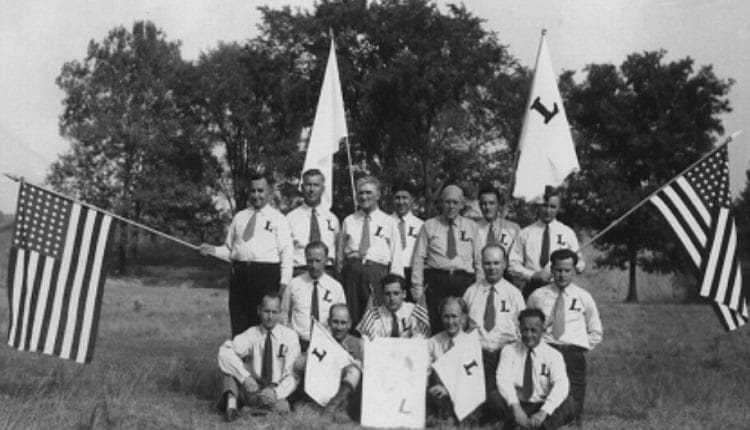
Hitler studied American genocide and Jim Crow before building the Reich. So when he came to power in 1933, plenty of Americans looked at Nazi Germany and thought, "this guy's onto something." By 1938, American fascists were forming up all over the country. The German American Bund held Nazi rallies at Madison Square Garden. Father Coughlin spread antisemitism to millions on the radio. The Silver Shirts - heading toward 20,000 members across twenty-two states - came to Minneapolis that summer with blood on their minds.
Their rhetoric sounds familiar now. Invading hordes poisoning the blood of the nation. Enemies within destroying Christian civilization. Jews and communists secretly controlling the government. Same old poison, new bottle.
The Chief and His Silver Army
He was a Hollywood screenwriter who'd won awards for his stories before he found his true calling the day after Hitler became chancellor of Germany. On January 30, 1933, Pelley founded the Silver Legion of America and declared himself "the Chief." His followers wore silver shirts with a scarlet L over the heart - Pelley claimed it stood for "Love, Loyalty, and Liberation," but really it just stood for loser. They wore blue ties and campaign hats. They looked like a weirdo varsity team for ethnic cleansing.
Sinclair Lewis had warned that if fascism came to America, it would be wrapped in the flag and carrying a cross - and Pelley proved him right. He wanted African Americans re-enslaved, Jews ghettoized and sterilized. He claimed Jesus personally approved the plan in a vision. In 1936, he ran for president on the Christian Party ticket under the slogan "For Christ and the Constitution."
But Pelley wasn't playing pretend. As the Silver Shirts gained power, they were heading toward 20,000 members across twenty-two states. They stockpiled weapons. Congressional investigators uncovered plots to steal arms from military arsenals. A young reporter named Arnold Sevareid went undercover at Minneapolis meetings and found middle-class citizens in their parlors, worshipping Pelley, planning to drive Jews from America.
By 1938, membership was declining. Pelley needed a win. He needed Minneapolis.
They Came with a Plan
In July 1938, Pelley sent his second-in-command to Minneapolis - Roy Zachary, a former lumberjack who'd reportedly said if no one else would assassinate Roosevelt, he'd do it himself. Just days before arriving, Zachary had given a speech in Spokane: "When we eliminate communism and Jews from the United States it will not be with the ballot, but with guns, wading in blood."
On July 29 and August 2, Zachary held private rallies at the Royal Arcanum Hall. Hundreds of invitations went out to Minneapolis businessmen and professionals. George Belden showed up - head of Associated Industries, the city's most powerful anti-union employer group. Republican Party officials came. The heads of company unions dedicated to destroying the Teamsters came.
The political timing wasn't coincidental. Minnesota's Farmer-Labor governor Elmer Benson, who'd appointed Jews to key positions, was facing re-election. The Silver Shirts wanted to defeat him using antisemitic attacks while simultaneously destroying Local 544. Two birds, one fascist stone.
Zachary's message wasn't subtle. Join the Silver Shirts. Join their fake "fink union." Prepare for an armed attack on Teamsters Local 544 headquarters. Pelley's goal was ambitious: recruit 3,000 to 5,000 new members in Minneapolis alone. That would make the city a Silver Shirt stronghold. He screamed about the "Communist racketeers" of Local 544, boasted that Silver Shirts were "infiltrating" the city's unions. When photographers tried to document who was attending, Silver Shirt guards jumped them. The photographers fought back and won, but the threat was real.
This wasn't just fascist theater. This was the business elite and armed fascists coordinating an assault on the most militant union in the Midwest.
The Teamsters Had Seen This Before
Local 544 wasn't just any union. In 1934, they'd fought the Citizens Alliance - the business cartel that had kept Minneapolis union-free for decades - and won. During the strikes, they'd battled the Alliance's private army of special deputies in the streets. On May 21, 1934, in what became known as the Battle of Deputies Run, teamsters routed over 1,500 armed deputies. Two deputies died. The Citizens Alliance's reign of terror ended that day.
Four years later, the bosses were back with a new strategy: bring in the fascists.
Local 544's leaders understood exactly what that meant. Several were Trotskyist organizers - Farrell Dobbs, Ray Dunne, Carl Skoglund - who'd recently consulted with Leon Trotsky in Mexico about anti-fascist organizing. They'd studied what happened in Germany and Italy when fascist thugs were allowed to operate freely. When workers waited for the government to act. When unions tried to play nice.
They knew the cops wouldn't help. The police were already promising to protect the Silver Shirts at their next rally.
So in August 1938, Local 544 formed the Union Defense Guard. Not an elite squad - it was open to any worker willing to defend the labor movement. Within weeks, 600 workers organized into squads of five. They trained. They armed themselves. The Northwest Organizer, the union's newspaper, announced it plainly on the front page: the Defense Guard existed for "defense of the union's picket lines, union headquarters and members against anti-labor violence."
Meanwhile, the Jewish Anti-Defamation Council organized its own resistance. Members went undercover in the Silver Legion, gathering intelligence. Other Jewish professionals formed a separate unit, training with bats and brass knuckles. In the fall of 1938, they raided a Silver Shirt meeting - masked men with Stars of David painted on their chests burst through the door and beat the fascists until they bled. No police reports were filed.
In mid-September, the Silver Shirts announced another Minneapolis rally. The Union Defense Guard decided to send a message.
One Hour's Notice
The Guard's leadership called an emergency mobilization with just sixty minutes' warning. Most members didn't even know it was a drill. They thought the Silver Shirts were attacking.
Three hundred armed workers assembled in downtown Minneapolis in under an hour. Ready for war.
The Silver Shirts got the message. They moved their next rally to St. Paul on October 28, where cops guarded the hall. Zachary stood before the crowd and tried to save face: "Leaders of 544 have said we cannot hold meetings in Minneapolis, but we shall hold them, with the aid of the police."
It was a lie and everyone knew it. The Silver Shirts never held another rally in Minneapolis. Their organizing drive collapsed. Zachary slithered away to other cities where workers hadn't organized to stop him - Chicago, Youngstown - where union defense guards beat him and his thugs bloody at every stop.
By 1939, federal prosecutors charged Minnesota Silver Shirt leaders with mail fraud. But what really killed the Silver Shirts was Pearl Harbor. When Japan attacked in December 1941, openly supporting Hitler suddenly became sedition instead of free speech. Pelley disbanded the Legion but kept publishing his fascist magazine, Roll Call. He couldn't help himself - he claimed the devastation at Pearl Harbor was worse than the government admitted. Roosevelt had finally had enough. In April 1942, federal agents arrested Pelley and charged him with sedition. He was convicted and sentenced to fifteen years, serving eight before his release in 1950. Zachary died in Seattle in 1949, his dream of an American Reich dead with him.
The bosses who funded them faced nothing. George Belden kept running Associated Industries. The Republican officials kept their positions. The businessmen who'd invited fascists to attack workers went home to their comfortable lives, unpunished.
What Actually Stopped Them
The government didn't stop the Silver Shirts. They investigated but let them operate. Most of the press ignored them or treated them as curiosities - Sevareid's exposé being a notable exception. Local police protected their rallies. Business leaders funded them.
What stopped them was workers who refused to wait for someone else to save them. The Teamsters and their allies understood that fascism only responds to force, that you can't debate your way out of a pogrom, and that the state will not protect you from the violence it enables.
Three hundred workers assembling in one hour with no warning. That's what broke the Silver Shirts in Minneapolis. Not laws. Not cops. Not politicians wringing their hands about civility.
Fascism is rising again, here and everywhere. The same rhetoric, the same scapegoating, the same promises of blood and purity. History keeps trying to teach us the same lesson: fascists don't stop because you ask nicely or vote harder or wait for institutions to save you.
They stop when communities organize locally and confront them directly. When workers, neighbors, and the vulnerable band together and make it clear that fascists aren't welcome. When people understand that sometimes the only answer to "we're coming for you" is "try it and find out."
The Teamsters knew it in 1938. We'd better remember it now.
Sources
- Joe Allen, "It can't happen here?" International Socialist Review, Issue 85, 2012
- Farrell Dobbs, Teamster Politics, Pathfinder Press, 1975
- William Millikan, A Union Against Unions: The Minneapolis Citizens Alliance and Its Fight Against Organized Labor, 1903-1947, Minnesota Historical Society Press, 2001
- Bradley Hart, Hitler's American Friends: The Third Reich's Supporters in The United States, St. Martin's Press, 2018
- Scott Beekman, William Dudley Pelley: A Life in Right-Wing Extremism and the Occult, Syracuse University Press, 2005
- HistoryLink.org, "Melee breaks out during a speech by the leader of the fascist Silver Shirts organization in downtown Spokane on July 18, 1938"
- University of Minnesota, "A Campus Divided" digital archive