Harlem Rises Up, Again - 1943
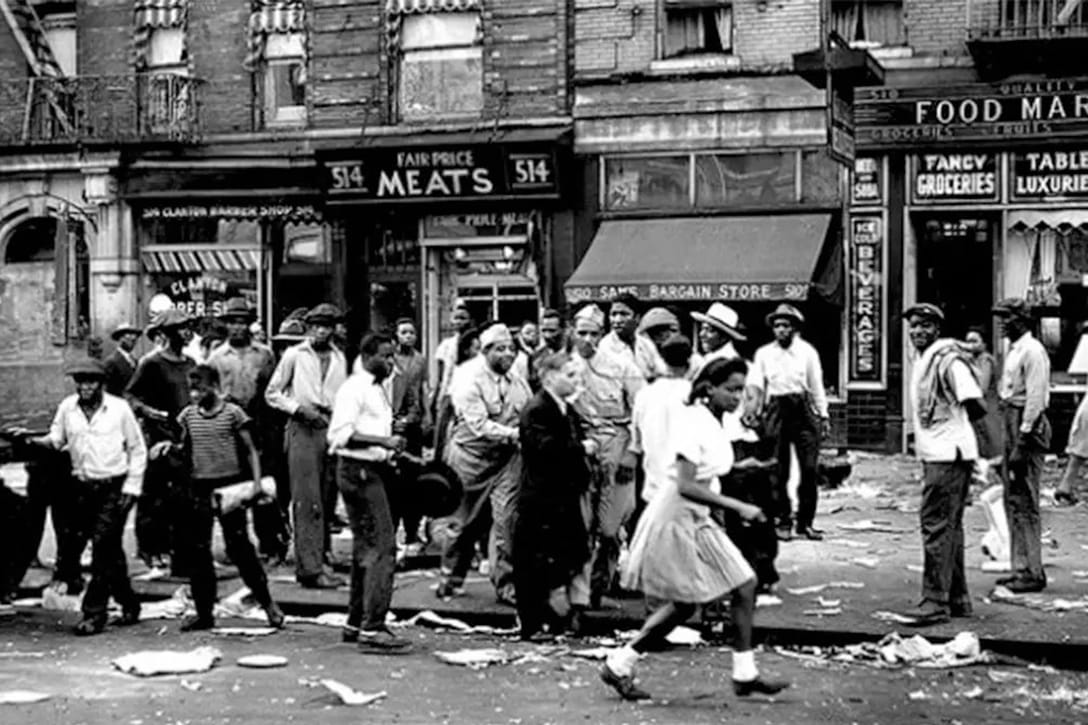
Harlem already exploded once, eight years before. Back in 1935, a rumor about a dead boy sparked three days of fury that left the neighborhood smashed and bleeding. The city blamed the community, filed away a report about systemic racism, and changed nothing. So when August 1, 1943 rolled around, the kindling was already stacked and bone-dry. All it took was one more spark.
Fighting Hitler Abroad, Fighting Jim Crow at Home
The summer of 1943 was a season of rage across America. Detroit had just burned in June - white mobs and Black residents clashing over jobs and housing, 34 people dead, most of them killed by police. In Beaumont, Texas, white shipyard workers rampaged through Black neighborhoods after a rumored rape, beating residents with hammers and burning homes to ash. Mobile, Alabama. Los Angeles. The whole country was simmering with racial violence as Black Americans were recruited to fight fascism overseas while being brutalized by it at home.
Black soldiers knew they were being played. They wore the uniform, fought under segregated conditions, and got harassed, beaten, and killed for it. Since Pearl Harbor, ten Black soldiers had been murdered by police or white civilians. Private David Wood was shot in the stomach while waiting for movie tickets at Fort Dix. Lynchings continued in the South. And all the while, white America asked Black men to die for freedom they'd never actually be given.
Langston Hughes captured it perfectly in his poem "Beaumont to Detroit: 1943" - You tell me that Hitler is a mighty bad man. I guess he took lessons from the ku klux klan. That was the bitter truth of 1943: the enemy America claimed to be fighting abroad looked a hell of a lot like the terror Black people faced at home.
Harlem was 89 percent Black by then, packed tight with families squeezed into overcrowded apartments because redlining and racist landlords kept them locked in. White flight had emptied the neighborhood of white residents, but white business owners still controlled the economy, price-gouging on everything from rent to groceries. Wartime rationing hit hardest where it always did - poor Black neighborhoods - and new war industries refused to hire Black workers even as they screamed for labor.
The pressure was unbearable. And on August 1, it broke.
The Braddock Hotel
The Braddock had been a destination once, back in the 1920s when Black celebrities and musicians stayed there during the Harlem Renaissance. By 1943, it was a flophouse known for prostitution. The military had designated it a "raided premise" and stationed a white cop in the lobby to keep soldiers away.
That Sunday night, a Black woman named Marjorie Polite checked in, hated her room, got moved, still wasn't satisfied, and checked out with a refund. Then she asked for her dollar tip back from the elevator operator. He refused. She got loud. Officer James Collins, a white rookie cop, grabbed her arm to arrest her for disorderly conduct. Polite screamed for help: Protect me from this white man!
Robert Bandy heard her. He was a 26-year-old private in the 730th Military Police Battalion, stationed in Jersey City, spending the weekend with his mother Florine Roberts, a domestic worker visiting from Connecticut. They'd just come back from the movies, in uniform, picking up luggage before dinner.
Bandy saw Collins manhandling Polite. His mother saw it too. They stepped in. What happened next depends on who you ask. The official police report said Bandy attacked Collins, grabbed his nightstick, hit him over the head, and tried to flee. Collins, lying on the ground, shot him. Bandy and his mother told a different story: Collins pushed Polite, threw his nightstick at Bandy, and when Bandy caught it and hesitated to give it back, Collins shot him.
Collins shot Robert Bandy in front of his mother. Bandy walked to the hospital with a superficial shoulder wound. He survived. But the rumor that spread through Harlem was that a white cop had murdered a Black soldier while he defended his mother.
Twelve Hours of Rage
Within an hour, 3,000 people gathered at the 28th precinct. Another crowd formed at Sydenham Hospital. Another at the Braddock. Mayor Fiorello La Guardia rushed to the precinct house, begging people to go home. Most didn't move. By 10:30 p.m., the first window shattered on 125th Street.
What followed wasn't random. It was targeted. Black-owned businesses posted signs frantically: Negro-Owned. Colored Store. The rage went straight for white-owned shops - the pawnshops, liquor stores, grocers, and clothing stores that had been gouging Harlem for decades. Glass exploded. Goods poured into the streets. Buildings burned. The neighborhood that had been caged and exploited for years tore itself apart and took its exploiters' property with it.
La Guardia deployed 6,600 cops, 8,000 National Guardsmen, and 1,500 civilian volunteers. They flooded Harlem with guns, clubs, and tear gas. By the morning of August 2, the streets looked like a war zone - broken glass, burned storefronts, debris everywhere. Six Black residents were dead, all killed by police. Nearly 500 people were injured. Over 600 were arrested. Property damage hit $5 million.
The hostages? There weren't any. The dead? None killed by rioters - only by cops.
What Happened to the Cop
James Collins walked away. No charges. No consequences. The Justice Department refused to prosecute because there was "no prospect of conviction." Just another white cop who shot a Black man and went home to dinner.
Robert Bandy recovered. He lived. But he became a symbol - not just of what happened that night, but of every Black soldier brutalized by the country they were dying for. Adam Clayton Powell Sr. said it plainly: When Bandy hit Collins over the head with that club, he was not mad with him only for arresting a colored woman, but he was mad with every white policeman throughout the United States who had constantly beaten, wounded, and often killed colored men and women without provocation.
Marjorie Polite became a folk hero. Langston Hughes wrote "The Ballad of Margie Polite," celebrating her defiance. If Margie Polite had of been white, she might not've cussed out the cop that night. The poem honored what everyone knew: Polite's crime wasn't yelling - it was being Black and refusing to be quiet about it.
James Baldwin was 19 that day. It was also his father's funeral. He wrote about the riot in Notes of a Native Son, describing the glass he'd smashed earlier that evening in his own rage, recognizing himself in the people who tore Harlem apart. Harlem had needed something to smash, he wrote. To smash something is the ghetto's chronic need.
The Pattern That Never Breaks
La Guardia tried to bury it. He downplayed the violence, but federal pressure forced some reforms - the Office of Price Administration opened a Harlem office to investigate price gouging, and landlords were pushed to comply with rent controls. The Savoy Ballroom, closed months earlier under the excuse of venereal disease (the real reason was interracial dancing), reopened.
But none of it addressed the root. Harlem would erupt again in 1964, sparked by another cop killing another Black teenager. The cycle would repeat across decades: police violence, community rage, official denial, cosmetic reforms, and then silence until the next time.
Harlem 1943 wasn't just about one soldier or one cop or one woman in a hotel lobby. It was about a country asking Black people to die for freedom while denying them every scrap of dignity at home. It was about a neighborhood squeezed, exploited, and brutalized until it couldn't take anymore. And when it finally broke, the state killed its own people and called it law and order.
We're still living in that story.
Sources
- Dominic J. Capeci Jr., The Harlem Riot of 1943 (Temple University Press, 1977)
- Nat Brandt, Harlem at War: The Black Experience in WWII (Syracuse University Press, 1996)
- Cheryl Greenberg, Or Does It Explode? Black Harlem in the Great Depression (Oxford University Press, 1991)
- James Baldwin, Notes of a Native Son (1955)
- Langston Hughes, "Beaumont to Detroit: 1943" and "The Ballad of Margie Polite"
- Hylan Lewis and Herbert Heyman, reports for the Office of War Information on the 1943 Harlem Riot (Schomburg Center archives)
- L. Alex Swan, "The Harlem and Detroit Race Riots of 1943," Berkeley Journal of Sociology
- Mariame Kaba, "Margie Polite, Police Violence, and the 1943 Harlem Riots"