Kent State Massacre
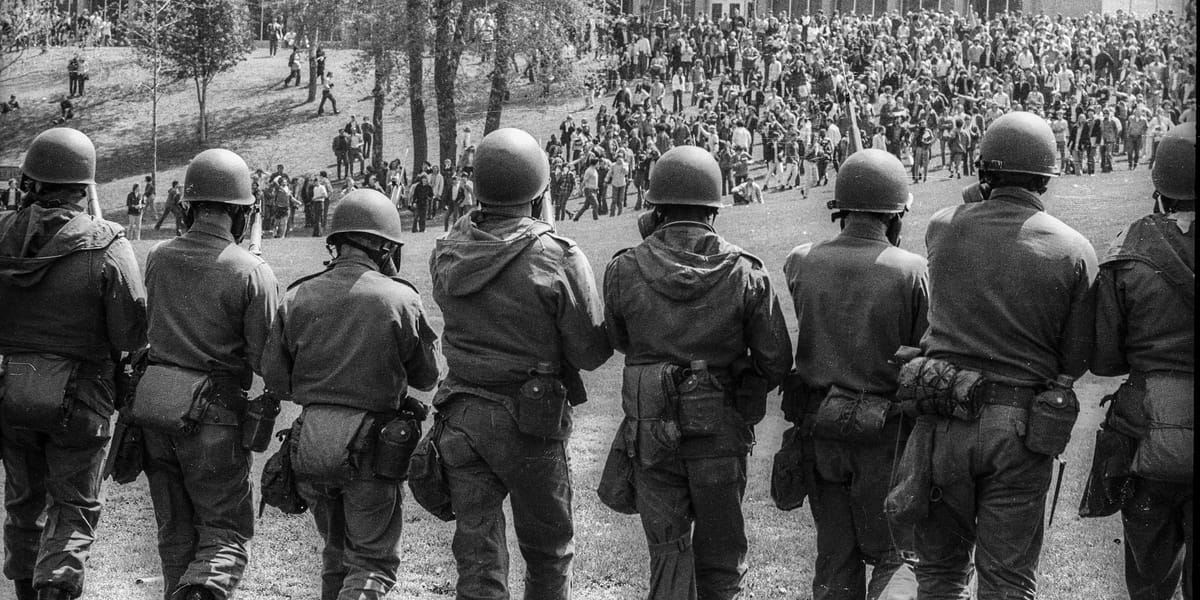
History echoes. It rhymes. Usually, we don't get to see history repeat itself until after the fact. But sometimes, events telegraph themselves in a way that it's impossible to not see what comes next.
Historically, deploying troops against American citizens, particularly those calling for basic human rights, never ends well. It won’t this time either.
You hear about Kent State more than some of the other events in this project, but what gets missed is how deliberate decisions by political leaders and law enforcement turned a campus protest into state violence.
History is repeating in real time, and it's worth exploring before the next "Four Dead in Ohio" has to be written.
The Spark
n May 1970, the Vietnam War was already dividing the country and fueling mass dissent. More than 400 American soldiers had died in Cambodia, Laos, and Vietnam in just the first months of the year. The draft lottery had been introduced the previous December, making the war feel like a death sentence for young men who had no political power. Across the nation, campuses were boiling with antiwar protests. Nixon’s announcement that he was expanding the war into Cambodia lit the fuse.
At Kent State University, students gathered, shouted, and burned a copy of the Constitution outside the ROTC building to symbolize a government breaking faith with its people. The protest was loud, angry, but it wasn’t war. The choice to turn it into one came from the top.
The Escalation
Governor James Rhodes smelled political opportunity. On May 3, 1970, he raged in a press conference that student protesters were “worse than the brownshirts and the communist element and also the night riders and the vigilantes.” He went further, saying they were “worse than the Communists or the Klan,” and vowed to “eradicate the problem.” That language wasn’t rhetoric, it was a green light. Troops from the Ohio National Guard were already on campus, exhausted after duty breaking a Teamsters strike. They came armed, anxious, and primed to see students as the enemy.
The administration declared an emergency. Helicopters flew overhead, dropping tear gas. Guardsmen lined up with loaded rifles, bayonets fixed. Rhodes called them his “troops in a war,” and they acted like it.
If that sounds familiar, it’s because that's the same language the President of the United States is using today. To expect it to end well this time is not just ignorant of history... To know what we know now, and use that language, you have to want something horrible to happen from either side. You are counting on atrocity. There is no other reasonable explanation for it.
The Massacre
On May 4, hundreds of students gathered on the Commons. Some were there to protest, some were simply cutting across campus to class. They chanted, sang, and threw tear gas canisters back at the Guard. A few tossed rocks and shouted, but many just stood and watched. Faculty tried to calm things, including geology professor Glenn Frank, who begged the Guard not to fire.
The Guard advanced anyway, pushing the students up and over Blanket Hill. Confused orders rang out, and the troops wheeled around. Witnesses said some Guardsmen knelt and took aim like they were on a rifle range. Others shouted at them not to shoot. Then came the crack of rifles.
Thirteen seconds of gunfire. Sixty-seven shots. Students scattered, some diving for cover, others frozen in shock. Four were left dead, nine more wounded. Allison Krause, Jeffrey Miller, Sandra Scheuer, and William Schroeder. Two were simply walking to class. One was an ROTC member. Dean Kahler, struck in the spine, would never walk again. Photographs captured a young woman screaming over Jeffrey Miller’s body, the image that seared Kent State into history.
This wasn’t chaos. It was predictable. It was state violence unleashed on unarmed students.
It’s still predictable.
The People
Allison Krause was nineteen, an honor student who had gone to the protest because she believed peace was worth standing for. Jeffrey Miller was twenty, outspoken against the war, his face later frozen in the photo that defined the massacre. Sandra Scheuer wasn’t protesting at all; she was walking to class when a bullet tore through her neck. William Schroeder, an ROTC cadet, believed in service but still opposed the war. He was shot in the back.
Dean Kahler survived but never walked again, paralyzed at nineteen. Others carried scars you couldn’t see, classmates who held their dying friends, kids who realized their government was willing to kill them.
They weren’t faceless. They were students, our fellow Americans, with futures that ended with government rifles.
The Aftermath
The killings at Kent State shocked the world. Even President Nixon’s own commission admitted the shootings were “unnecessary, unwarranted, and inexcusable.” But words cost nothing. No Guardsman or commander ever went to prison. Governor Rhodes faced no punishment. The system closed ranks, dragged survivors through the courts, and eventually paid out token settlements without admitting guilt.
Just ten days after Kent State, in Jackson, Mississippi, police opened fire on students at Jackson State College, killing two young Black men and wounding a dozen others. That massacre drew less national outrage, in part because the victims were Black, but the message was the same: dissent would be met with state violence.
For the families at Kent State and Jackson State, there was no justice. For politicians, there were no consequences. What lingered was the lesson to future leaders, that you could turn rifles on students and walk away.
Kent State wasn’t a tragedy of confusion. It was the predictable result of pouring gasoline on anger and lighting a match. Leaders made choices. They chose escalation, demonization, and force. They chose to put troops with live ammunition on a college campus and told them the enemy was students.
And they pulled the trigger.
If you want to know what comes next when politicians talk about “full force” against protest, Kent State already gave the answer. The next time troops line up across from citizens, don’t say we weren’t warned.
Sources
- James A. Michener, Kent State: What Happened and Why (1971)
- William A. Gordon, Four Dead in Ohio: Was There a Conspiracy at Kent State? (1990)
- Philip Caputo, 13 Seconds: A Look Back at the Kent State Shootings (2005)
- Jerry M. Lewis and Thomas R. Hensley, “The May 4 Shootings at Kent State University: The Search for Historical Accuracy” (Kent State University, 1998)
- U.S. President’s Commission on Campus Unrest (Scranton Commission Report, 1970)
- John Kifner, “4 Kent State Students Killed by Troops,” New York Times, May 5, 1970