Minneapolis Teamsters Strike, 1934
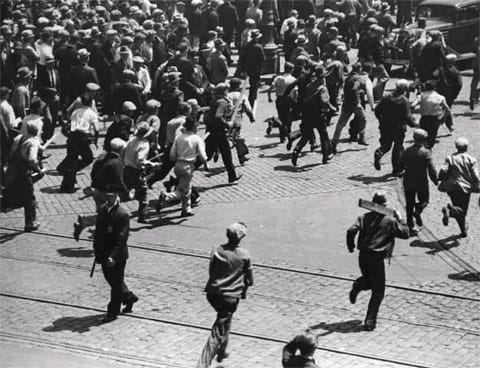
They called Minneapolis a "scab's paradise" - until the truckers had enough. In 1934, with drivers making starvation wages and bosses treating workers like disposable cattle, Minneapolis Teamsters shut down an entire city and broke the back of one of the most vicious anti-union machines in American history. When cops opened fire on unarmed strikers that July, shooting 67 men mostly in the back, they showed America exactly what the state thinks of workers who dare to fight back.
The Fortress Falls
Minneapolis was ruled by the Citizens Alliance - a cabal of business owners who'd crushed every major strike since 1916. They ran spy networks, maintained blacklists, and raised private armies. For two decades, they'd perfected the art of breaking workers through violence and fear.
By 1934, the Depression had pushed workers past their breaking point. Truck drivers were making $12-14 a week for 10-hour days. Coal haulers worked until midnight for 20-30 cents an hour - when they could find work at all.
Meanwhile, Trotskyist organizers led by Carl Skoglund and the Dunne brothers had infiltrated Teamsters Local 574 with a radical idea: unite all workers - drivers, loaders, warehouse workers - into one industrial union. After winning a small coal yard strike in February, membership exploded from 75 to over 5,000.
On May 16, they struck citywide. They demanded union recognition, decent wages, and the right to represent "inside workers." The bosses refused to even negotiate.
Deputies Run
The Citizens Alliance responded with violence, as always. Police Chief Mike Johannes and the Alliance deputized 1,500 "special police" - thugs with badges recruited from what one striker called "ex-crooks, murderers, and all the scum of the city, including gentlemen from the social register."
On May 21-22, twenty thousand people packed the market district for what became the "Battle of Deputies Run." The strikers had turned their headquarters into a military command center - dispatch riders, a commissary feeding thousands, even their own radio broadcasts. When battle erupted, they fought with precision, flanking the deputies, overwhelming them with tactical superiority.
The special police fled, throwing away badges and clubs as they ran. Two deputies died - C. Arthur Lyman, a Citizens Alliance attorney, and Peter Erath. The establishment was shocked. Workers weren't supposed to win street battles.
Governor Floyd B. Olson, the Farmer-Labor governor who claimed to support workers, called a truce. On May 25, a settlement was reached: union recognition, reinstatement of all workers. Victory.
Or so they thought.
Bloody Friday
The bosses immediately betrayed the agreement. Within weeks, over 700 union members were fired. The Citizens Alliance pressured employers to break their word.
On July 17, Local 574 struck again. This time, union leaders ordered pickets to go unarmed - no clubs, no weapons. They wanted to prove they weren't the violent mob the press painted them as.
The police armed themselves with shotguns loaded with buckshot.
July 20, 1934 - Bloody Friday. A truck escorted by fifty armed cops tried to make a delivery near 3rd Street and 6th Avenue. When picketers moved to stop it, police opened fire. Not warning shots. They aimed to kill.
Henry Ness, a World War I veteran and father of four, took 38 slugs. Doctors pulled them out one by one as he lay dying. His last words: "Tell the boys not to fail me now."
John Belor, who'd come to support the strikers, was shot dead.
Sixty-seven others were wounded, almost all shot in the back as they fled or tried to help the fallen.
Governor Olson's own commission later confirmed what everyone already knew: "Police took direct aim at the pickets and fired to kill. Physical safety of the police was at no time endangered. No weapons were in possession of the pickets."
The Reckoning That Wasn't
One hundred thousand people lined the streets for Henry Ness's funeral. The entire city bore witness.
Olson declared martial law, sending 4,000 National Guardsmen to occupy Minneapolis. They raided union headquarters and arrested strike leaders. Only under massive public pressure did they also raid Citizens Alliance offices, finding evidence of plans to sabotage any settlement.
Finally, on August 22, A.W. Strong and the Citizens Alliance broke. They accepted the union's demands: minimum wage, union recognition, the right to represent all members. The "scab's paradise" was dead. Within months, unions organized across Minneapolis. The victory helped force passage of the National Labor Relations Act in 1935.
But here's what they don't tell you:
No cop ever faced charges for Bloody Friday. No Citizens Alliance member was prosecuted for organizing private armies. The killers of Henry Ness and John Belor went home to their families.
And the Trotskyists who made it all possible? In 1941, eighteen leaders of Local 544 and the Socialist Workers Party were imprisoned under the Smith Act - the first victims of that anti-radical law. The militants who taught Minneapolis workers how to fight were removed from power, their methods buried.
That's the pattern, isn't it? Workers bleed for their victories. Bosses and their hired guns walk free. Every gain is temporary, always under attack, always having to be won again.
Minneapolis 1934 proved workers could win against impossible odds. It proved solidarity could break corporate power. But it also proved the state will always side with capital when push comes to shove - that even sympathetic politicians will send in the Guard before they'll let workers truly win.
They still call it the Minneapolis Truckers Strike. But it was bigger than that. It was the moment American workers remembered they could fight back - and win.
Sources
- Philip A. Korth, The Minneapolis Teamsters Strike of 1934, Michigan State University Press, 1995
- Charles R. Walker, American City: A Rank and File History of Minneapolis, University of Minnesota Press, 2005
- William Millikan, Union Against Unions: The Minneapolis Citizens Alliance and Its Fight Against Organized Labor, 1903-1947, Minnesota Historical Society Press, 2001
- Farrell Dobbs, Teamster Rebellion, Monad Press, 1972
- Minnesota Historical Society, "Minneapolis Teamsters Strike of 1934"