Paterson Silk Strike, 1913
Picture this: 1,000 striking silk workers storming Madison Square Garden to perform their own story on stage. A 90-foot painting of factory smokestacks as the backdrop. Twenty-thousand people in the crowd singing the Internationale. A 17-year-old girl who got arrested five times and sang all the way to jail every single time. Immigrant workers who spoke a dozen different languages running their own democratic strike meetings with 20,000 people on a lawn in New Jersey.
This actually happened. In 1913. And you've probably never heard of it.
Twenty-five thousand silk workers shut down an entire industry for five brutal months. They built something extraordinary - a multiethnic, radically democratic movement that practiced the kind of solidarity bosses have nightmares about. They staged one of the most audacious pieces of political theater in American history. They proved that workers could govern themselves.
And then they lost.
Between 1909 and 1913, textile workers were rising up across the Northeast. The IWW had just won in Lawrence, Massachusetts. Mill owners everywhere watched, terrified. Paterson was supposed to be the next domino. The bosses made damn sure it wasn't. But what happened there - what the strikers built and how they lost - that's a story that should be a blockbuster. Instead, it's been buried.
Silk and Speed-Up
By 1913, Paterson churned out nearly half of America's silk. Three hundred mills powered by the Great Falls, where human beings got treated like machine parts. Skilled weavers - mostly Italian, Jewish, and Eastern European immigrants - ran two massive looms at a time, 10-hour days, six days a week. Kids as young as nine worked beside them.
The mill owners had the courts, the cops, the newspapers. What they didn't count on: workers who'd already learned to fight back in the old country.
In 1911, the Doherty Silk Company opened a new mill with a four-loom system. The writing was on the wall. Speed-up, layoffs, race to the bottom.
When owners tried forcing the four-loom system in early 1913, the weavers walked. Ribbon weavers joined them. Dyers' helpers joined them. Women who'd been told to stay quiet joined them. By February 25, 25,000 workers had shut down the Silk City.
Democracy in Action
The Wobblies sent organizers fresh off Lawrence. Big Bill Haywood showed up and got arrested immediately. Elizabeth Gurley Flynn, 22 years old, got arrested the first day for talking about unity across racial lines. Carlo Tresca came to organize. But the workers ran this strike themselves.
Every week, thousands met at Turn Hall or outside Pietro and Maria Botto's home in Haledon, where the socialist mayor let them gather without cops cracking skulls. Sundays, 20,000 packed the Bottos' lawn. Direct democracy - Italian, Jewish, Polish, and English-speaking workers hammering out demands together. Eight-hour day, better wages, end child labor, no four-loom system.
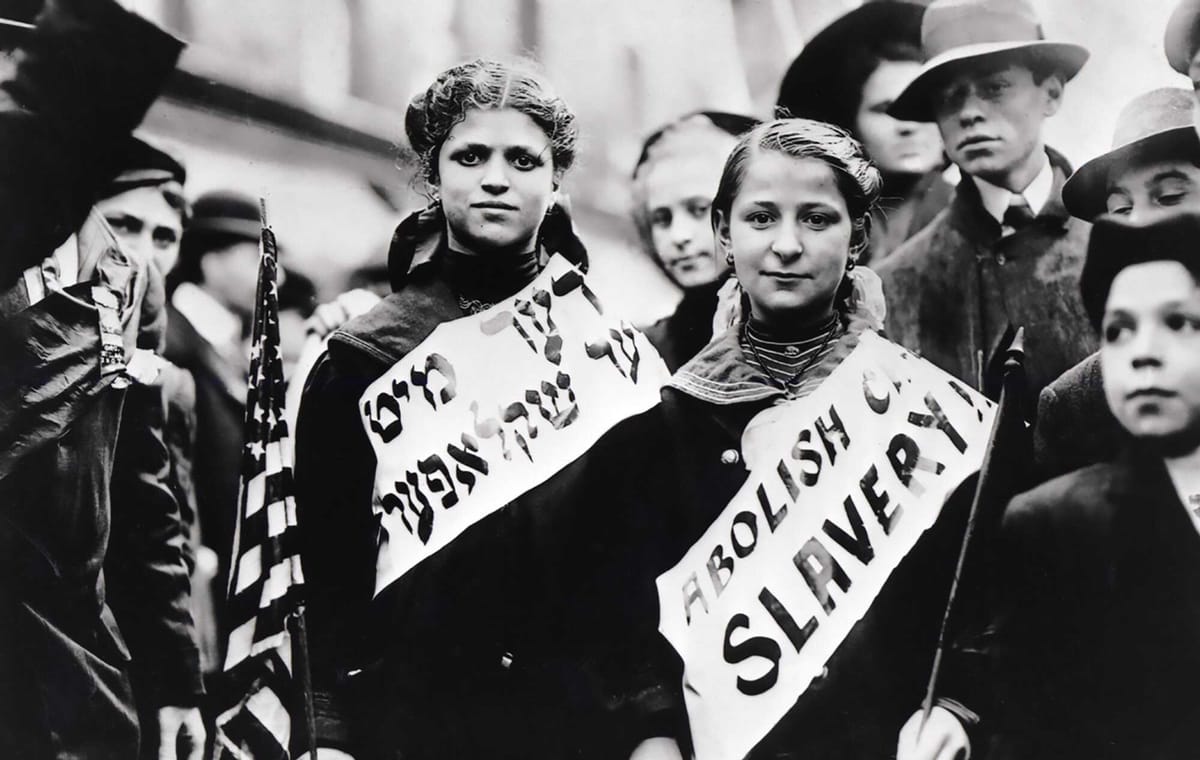
Women led. Flynn held weekly meetings for women strikers. Hannah Silverman, 17-year-old Jewish weaver, became picket line captain. Arrested five times. When a judge threatened to ship her to a state home if she picketed again, she went right back, chased a strikebreaker down the street yelling the Yiddish word for shame. Got 20 days for hissing at a judge. Sang all the way to jail. Carrie Golzio, Italian mother and silk inspector, organized rallies. Badasses, every one.
Two Murders
April 17, 1913. Modestino Valentino stood on his porch with his infant daughter, watching company detectives force strikebreakers onto a trolley. Valentino wasn't a striker. Wasn't even a silk worker. A detective's bullet tore through his back anyway. He died on his doorstep beside his pregnant wife.
Twenty thousand strikers walked in his funeral. They dropped red carnations into the grave until it disappeared beneath a sea of red. Blood for blood, shouted Tresca.
No one was charged.
June 29. Striker Vincenzo Madonna, shot dead by a strikebreaker. Again, no charges.
Message received: you can kill workers and walk away.
The Pageant That Broke Them
By June, families were starving. Mill owners had shifted production to Pennsylvania. Desperate, the strikers tried something audacious: stage a massive pageant at Madison Square Garden.
John Reed organized it. June 7, 1913, over 1,000 strikers performed their own story. The mills, the picket lines, the beatings, Modestino's murder. They sang the Internationale. A 90-foot painting of the Paterson mills loomed over everything.
Reviews were glowing. The pageant itself was a triumph. But it raised almost nothing. Reed had promised it would save them. It didn't. Morale collapsed immediately.
Defeat
The strike limped on seven more weeks. Ribbon weavers broke first, went back July 18. Most followed July 28, defeated and desperate. Same brutal conditions. The four-loom system came anyway, just took a decade longer.
No one answered for two murders. Nearly 1,850 arrested workers got fines, jail time, blacklists. Hannah Silverman spent the rest of her life behind a candy store counter. The IWW never recovered in the East.
The system was rigged. Mill owners had courts, cops, press, and the ability to starve workers out while moving production elsewhere.
But what the strikers built mattered. They proved workers could govern themselves. That immigrants could unite across every line. That women and teenagers could lead. That art and revolution could walk together.
It took until 1919 for silk workers to win the eight-hour day. The Paterson strikers didn't live to see it. Every gain that came after was built on strikes like theirs.
Pietro and Maria Botto's house still stands. It's a museum now. The songs are still sung. The lessons didn't die in 1913.
The powerful won because they had more resources, more guns, more patience for human suffering. But the strikers showed them what happens when people refuse to kneel.
That terrified them then. Should terrify them now.
Sources
- Steve Golin, The Fragile Bridge: Paterson Silk Strike, 1913 (Temple University Press, 1988)
- Anne Huber Tripp, The I.W.W. and the Paterson Silk Strike of 1913 (University of Illinois Press, 1987)
- PBS American Experience, "The Paterson Silk Strike of 1913"
- Elizabeth Gurley Flynn, "The Truth About the Paterson Strike" (1914)