St. Louis General Strike, 1877
The summer of 1877 saw America's railroads explode in the largest labor uprising the country had ever witnessed. From Martinsburg to Pittsburgh to Chicago, workers stopped the trains and fought back against starvation wages. Cities burned. Militias shot into crowds. Over 100 people died nationwide. But nowhere did the strike transform into something bigger, something more radical, than St. Louis.
For about a week in July, workers ran the city. Not symbolically. Not metaphorically. Actually ran it. They shut down the railroads, the foundries, the breweries, the packinghouses, the mills. They formed an Executive Committee, took over city functions, and kept order while the police cowered behind their cannon. It was the first general strike in American history, and for a brief, shining moment, it looked like the Paris Commune had crossed the Atlantic and landed in the heartland.
Then the bosses called in the cavalry.
When the Railroads Coordinated Starvation
By 1877, America was choking on the fourth year of the Long Depression. The Panic of 1873 had gutted the economy - over 18,000 businesses failed, iron and steel production collapsed by 45%, and more than a million people lost their jobs. The railroads, bloated from post-Civil War speculation, had been cutting wages for years. Workers who once made decent money now watched their families go hungry while railroad executives approved dividend increases for shareholders.
In May 1877, the four major trunk lines - the Baltimore & Ohio, the Pennsylvania, the New York Central, and the Erie - met in secret and coordinated a 10% wage cut across the board. They figured workers were beaten down enough that they wouldn't fight back. They figured wrong.
On July 16, railroad workers in Martinsburg, West Virginia walked off the job. The strike spread like a match dropped in dry grass - Baltimore, Pittsburgh, Chicago. Pittsburgh turned into a war zone, with 61 dead and the city center burned. Baltimore saw at least 10 killed by National Guard gunfire. This wasn't isolated labor unrest. This was class warfare, and it was coming to St. Louis.
The Commune Begins
On Sunday night, July 22, the strike hit East St. Louis. Track superintendent E.L. Jones ordered workers to man the switches at the Relay Depot. A striker named Jack Benson stepped forward: "We allow no men to work for wages." Just like that, all freight stopped. Passenger trains, too.
The Workingmen's Party - a thousand-strong Marxist organization, most of them German immigrants who'd fled the failed 1848 revolutions - saw their moment. On Monday night, July 23, they organized a rally at Lucas Market in downtown St. Louis. Thousands showed up to hear fiery speeches in English and German. Peter Lofgreen, a Danish immigrant and party organizer, didn't mince words: "The capitalists was trying to starve the workingmen and was educating his children to look down on them, despise and grind them under foot at every chance."
The next day, Tuesday, July 24, they marched. About 500 workers, led by Albert Currlin, a German baker and veteran of the First International, crossed the Eads Bridge from East St. Louis singing "La Marseillaise." They went from workplace to workplace - steamboats on the levee, foundries, factories - shutting everything down. Black dock workers joined white rail workers. The St. Louis Republic would later report, scandalized, that workers "of all colors" marched together under a huge American flag with a banner reading "NO MONOPOLY - WORKINGMEN'S RIGHTS."
By Wednesday, the city was paralyzed. Flour mills, bakeries, chemical plants, zinc works - all stopped. Newsboys quit selling papers. Union Depot stood empty. The strikers unfurled the red flag of the International at the zinc works. An estimated 10,000 people packed Lucas Market that night. One speaker, Thomas Curtis, declared: "This is not a strike - but a social revolution!"
The Executive Committee of the Workingmen's Party - at least 47 people whose identities were never fully recorded - effectively governed the city. They issued General Orders. They decided which businesses could stay open (bakeries, to feed people). They demanded a 50% wage increase, an eight-hour workday, a ban on child labor, and nationalization of the railroads and telegraph. When the Belcher Sugar Refinery came hat-in-hand asking permission to operate, the Committee decided its fate.
The Missouri Republican newspaper shrieked in terror: "The Internationalists have taken control of the strike, same as the communists who took control of Paris." For once, they weren't exaggerating.
The Limits of Solidarity
But the commune had a fatal flaw: racism. Albert Currlin, one of the key leaders, turned away roughly 500 Black workers who wanted to join the mass meetings. "We replied we wanted nothing to do with them," he bragged to the St. Louis Times afterwards. The press stoked the divisions, calling Black strikers "a dangerous-looking set of men" who were "blood-curdling in the manner in which they shouldered their clubs."
Not all the leaders were like Currlin. The Executive Committee did demand 50% wage increases for the Black boatmen on the levee, the same as for white railroad workers. At one mass meeting, a Black worker stood and asked the crowd if white workers would stand with him. The crowd roared: "We will!" But the damage was done. The racist faction's refusal to fully embrace Black workers weakened the movement when it needed unity most.
And critically, fatally, the Workingmen's Party leadership didn't arm the workers. They talked about revolution. They ran a city. But when workers showed up at strike headquarters asking for weapons, they got nothing.
The Reckoning
Mayor Henry Overstolz made his choice early: side with capital. A German immigrant himself, but a successful businessman first, he formed a Committee of Safety with former Confederate General John Marmaduke and former Union General Andrew Smith. These men, who'd spent the Civil War trying to kill each other, united seamlessly to crush workers demanding bread.
On Friday, July 27, Overstolz personally led 600 armed civilians - drawn from the city's business elite and armed with rifles from the state armory - to Schuler's Hall, the strike headquarters. A vanguard of mounted police charged in. They arrested 75 strikers while the rest fled through windows. Not a shot was fired, because the strikers had no guns to fire.
The next morning, federal troops took over the East St. Louis rail yards. Seven companies of Illinois National Guard troops marched in. By August 1, it was over. About 18 people died in the violence. Two weeks later, a judge released nine strike leaders because prosecutors couldn't produce witnesses - the solidarity held that far, at least.
The St. Louis Commune had lasted less than a week.
The Velvet Glove
Eight months after the strike was crushed, two former Confederate officers - brothers Charles and Alonzo Slayback - called a meeting at the swank Lindell Hotel. In March 1878, they founded the Veiled Prophet Organization, a secret society of St. Louis's wealthiest businessmen. The name came from a Thomas Moore poem about a tyrant who rules through mystique and terror, veiling his face to hide his true nature. It was bullshit. They were terrorists, no different than the Klan.
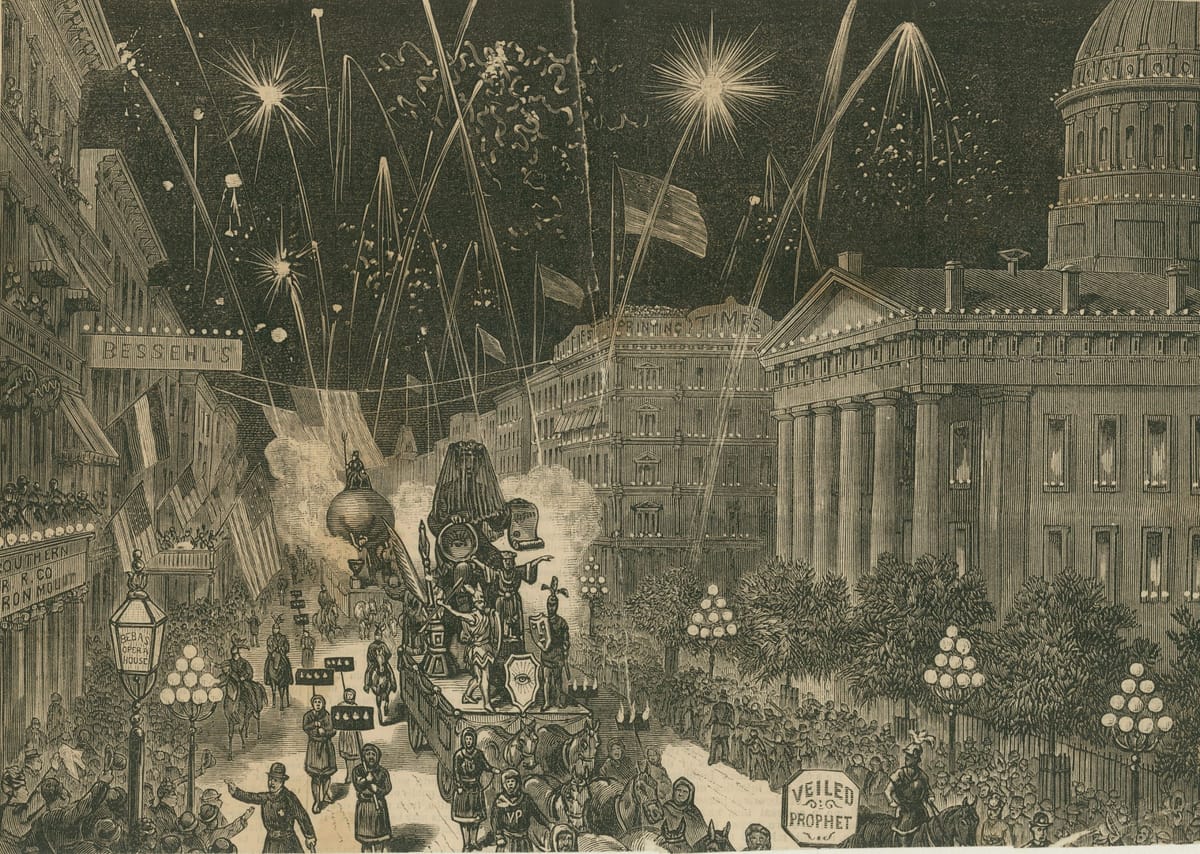
On October 8, 1878, exactly one year and a day after federal troops broke the strike, they held their first parade. They rode floats bought from New Orleans Mardi Gras, and the first Veiled Prophet - the only one ever publicly revealed - was Police Commissioner John G. Priest, the man who'd helped put down the workers. The Missouri Republican ran a woodcut showing him in robes that looked like Klan garb, armed with pistols and shotguns. The caption noted the parade "is not likely to be stopped by street cars or anything else" - a direct shot at the strikers.
The white hoods and robes wouldn't become the KKK's standardized uniform until 1915, but the 1870s Klan used the same hooded, armed costumes to terrorize Black people and labor organizers. The Veiled Prophet deployed identical symbolism, served the same function, scared the same people. Workers and Black St. Louisans knew what they were looking at. The literary cover story was just that - cover.
This wasn't reconciliation. It was a victory lap. The parade's message was clear: the natural order had been restored, the hierarchy re-established, and the men who owned St. Louis would never let workers forget who was really in charge.
The Veiled Prophet Ball became an annual celebration of elite power, whites-only until 1979, a debutante ritual where wealthy men presented their daughters to other wealthy men. The ball still happens every December, still run by the same organization (now calling itself "VP St. Louis"). In 2023 they finally dropped the Veiled Prophet figure - replacing him with a nearly identical masked character called the "Grand Oracle." Different veil, same bullshit, same families.
What Got Buried
The St. Louis General Strike should be taught in every American history class. It was the first general strike on U.S. soil. It was the only time an American city was governed by a communist party. It proved that Black and white workers could unite against their bosses. It demonstrated what organized labor could accomplish when it moved beyond single-issue bargaining to demand systemic change.
Instead, it's been memory-holed. Most Americans have never heard of it. St. Louis barely remembers its own history. The Great Railroad Strike of 1877 gets mentioned in passing, if at all, as a footnote to the Gilded Age - a speed bump on capital's road to dominance.
Meanwhile, the bosses learned their lessons. They strengthened police forces. They organized private militias. They built National Guard armories with gun slits in the walls. They practiced coordination between corporate power and state violence. The next time workers rose up, the response would be even more brutal - and it was, repeatedly, for the next fifty years.
The workers learned lessons too, but they wouldn't get another chance like St. Louis for decades. The commune failed because it hesitated. Because racism fractured solidarity. Because the leadership talked revolution but didn't prepare for the inevitable counterattack. Because they believed their moral authority and the justice of their cause would be enough.
It wasn't. It never is. The bosses don't care about justice. They care about power, and they will use as much violence as necessary to keep it.
That's the real legacy of St. Louis 1877: a glimpse of what's possible, crushed by what's probable. Workers briefly held a major American city, ran it better than the capitalists did, and proved that another world is possible. Then the men with guns showed up, backed by men with money, and it all came crashing down.
The Veiled Prophet danced on the rubble.
Sources
- Mark Kruger, The St. Louis Commune of 1877: Communism in the Heartland (University of Nebraska Press, 2014)
- David T. Burbank, Reign of the Rabble: The St. Louis General Strike of 1877 (Augustus M. Kelley, 1966)
- Thomas M. Spencer, The St. Louis Veiled Prophet Celebration: Power on Parade, 1877-1995 (University of Missouri Press, 2000)
- Philip S. Foner, The Great Labor Uprising of 1877 (Monad Press, 1977)
- David O. Stowell, ed., The Great Strikes of 1877 (University of Illinois Press, 2008)
- "1877 St. Louis General Strike," Wikipedia
- Tim O'Neil, "1877 Railroad Strike Paralyzed City," St. Louis Post-Dispatch, July 27, 2023