The Bread and Roses Strike, 1912
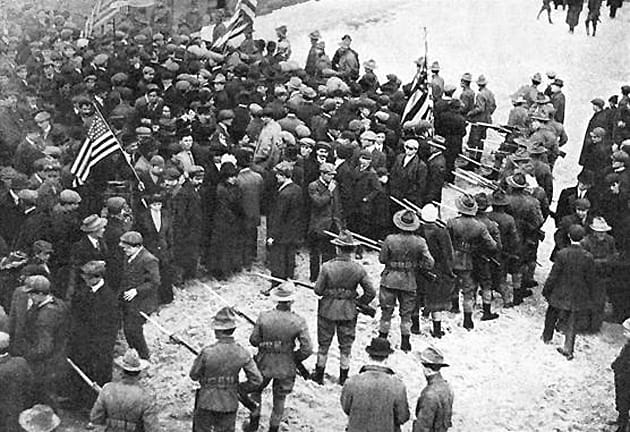
The phrase "Bread and Roses" sounds poetic, romantic even. Bread for survival, roses for dignity - the idea that workers deserve more than starvation wages, they deserve lives worth living. But there was nothing romantic about Lawrence, Massachusetts in January 1912. It was 20,000 textile workers - most of them women and girls - walking off the job in the dead of winter because mill owners cut their wages to starvation levels. Two workers were killed by cops and militia. Hundreds were arrested. Mothers were beaten at a train station for trying to send their hungry children to safety. And when a 14-year-old girl with a partially bald head sat before Congress and explained in a quiet voice how a machine had scalped her, the whole country finally paid attention.
The workers won. At least, for a while.
Short Pay
On January 11, 1912, Polish women weavers at the Everett Mill opened their pay envelopes and found them light. Thirty-two cents short. The cost of four loaves of bread. When a mill official asked why they'd stopped working, the answer was simple: "Not enough pay."
This was Progressive Era America. Reformers pushed for labor protections, women's suffrage, trust-busting. But progress came slow. The gap between industrial titans and the workers who made their fortunes was a chasm. Between 1900 and 1910, over 8 million immigrants arrived, most ending up in factories like Lawrence's mills. They were supposed to be grateful. Instead, they were starving.
Massachusetts had just passed a law cutting the maximum workweek for women and children from 56 hours to 54. Progressive reform. The mill owners cut everyone's pay to match. Workers making $8.76 a week would now make less.
The Polish women didn't hesitate. They shut down their looms, marched through the mills shouting "Short pay! Short pay!" and pulled other workers into the streets. By the next day, 10,000 were out. Within a week, more than 20,000 had walked off. They sang on picket lines in dozens of languages. Lawrence's textile industry ground to a halt.
The City
Lawrence was an immigrant city. Over 50 nationalities, speaking dozens of languages, crammed into seven square miles. The mill owners built it that way. Keep workers divided, and they'd never organize.
Life was brutal. Workers - including children as young as 13, some younger with forged papers - labored in mills where cotton dust destroyed lungs, machines deafened, and a third died before age 25. Entire families worked just to afford rent and food. And even then, they were hungry.
The IWW sent organizers. They helped workers organize themselves. A strike committee formed with representatives from every ethnic group. Meetings translated into nearly 30 languages. Soup kitchens fed families. The Wobblies' strategy: organize everyone. Skilled and unskilled, men and women, every nationality, every language. In Lawrence, it worked.
The Violence
Mill owners responded with force.
Police clubbed picketers. The state militia marched in - 22 companies with fixed bayonets. Harvard students got exam exemptions if they'd go break the strike. On January 29, police and strikers clashed. In the chaos, Anna LoPizzo was shot and killed. The next day, 17-year-old John Ramey was bayoneted in the back by a soldier. Cops arrested IWW organizers Joseph Ettor and Arturo Giovannitti for being accessories to LoPizzo's murder, though neither was anywhere near the scene and she was almost certainly shot by police.
It didn't work. The IWW sent more organizers. Big Bill Haywood came. So did Elizabeth Gurley Flynn, 21 years old and already legendary. She helped organize the children's exodus and spoke at mass meetings. Women led some of the most militant picket line actions. The strike held.
The Children
Then the workers did something brilliant. They started sending their children away.
On February 10, 119 children boarded trains to New York. Five thousand people greeted them at Grand Central, cheering. More went the following week, parading down Fifth Avenue. Fewer mouths to feed, and devastating propaganda. The contrast between well-fed New York children and Lawrence's hungry, ragged kids told the story.
Lawrence authorities couldn't let it continue. On February 24, when families brought 46 more children to the station bound for Philadelphia, City Marshal John J. Sullivan ordered them to disperse.
When mothers refused, police attacked. Cops beat women with clubs, dragged them by their hair, wrenched crying children from their arms. Mothers fought to get their kids on the train. Police arrested them while their children screamed. Journalists watched. Cameras caught it.
The photos made national newspapers. The brutality was undeniable - the state attacking mothers for trying to feed their children. The whole country was watching, and Lawrence's authorities looked exactly like what they were: thugs serving the mill owners.
Carmela's Voice
Congress held hearings in early March. Workers testified. Children testified. One after another, they described the mills.
Then came Carmela Teoli. She was 14, soft-spoken, partially bald. The room strained to hear her.
A man had come to her house when she was 13, she explained. He told her father he could get papers saying she was 14, old enough to work. It cost $4. A month later, forged papers arrived. Two weeks after she started, a cotton-twisting machine grabbed her hair and tore off part of her scalp. Seven months in the hospital. The company paid medical bills but no sick pay. When she got out, she had to go back to work.
Why did she join the strike? a congressman asked.
"Because I didn't get enough to eat at home," she said.
Helen Herron Taft, the First Lady, was in the audience. She invited Carmela to the White House. The Tafts donated $1,000 to strike relief. Carmela's testimony made national headlines.
The mill owners caved. On March 12, the American Woolen Company agreed to wage increases of 5 to 20 percent, overtime pay, no retaliation. Other mills followed within days. The victory rippled out - at least 500,000 textile workers across New England got raises.
The workers had won.
Who Paid for This
William Wood, president of the American Woolen Company, got richer. He'd even paid an undertaker named John Breen $500 to plant dynamite around town to frame the strikers - Breen got caught, was fined $500, and walked free. John J. Sullivan, the city marshal who ordered cops to beat mothers and children at the train station, faced no consequences. Neither did the mill owners who worked children to death, the politicians who called in the militia, the judges who jailed organizers on false charges, or the cops who killed Anna LoPizzo.
None of them ever answered for what they did.
Carmela Teoli went back to work in the mill. She was never promoted. Workers who hadn't struck got better jobs as rewards. Carmela kept her head covered with a bun for the rest of her life, hiding the bald spot. Her own children didn't know about her testimony until decades later. She'd never told them.
Within a few years, the workers lost nearly everything they'd won. The IWW refused to sign contracts, believing they made workers complacent. Mill owners chiseled away at wages and conditions, fired union activists, planted spies. By the time workers realized what was happening, the victory had been dismantled.
The Pattern We Still Live With
Lawrence wasn't unique. Owners squeeze workers. Workers fight back. The state picks a side, and it's rarely ours.
Anna LoPizzo was shot by police. John Ramey was bayoneted in the back by militia. Carmela Teoli was scalped by a machine at 13 and testified at 14. Months after the strike ended, a Lithuanian immigrant named Jonas Smolskas was beaten to death for wearing a pro-labor pin. These are the names. There are always names. And there are always people who faced no consequences for what they did to them.
Today's gig economy, wage theft, union-busting - same game, fresh paint. Workers still fight for bread and roses. The bosses still call the cops when workers get too uppity.
Lawrence proved something that terrified the bosses: immigrant workers, women workers, child workers, the people written off as "unorganizable" could win when they stood together across every line meant to divide them.
Big Bill Haywood told the strikers when it was over: "You have won over the opposed power of the city, state, and national administrations, against the opposition of the combined forces of capitalism, in face of the armed forces. You have won by your solidarity and brains and muscle."
Solidarity. That's the word the bosses fear most. That's what Lawrence was about. That's what every labor fight should still be about.
Sources
- Bruce Watson, Bread and Roses: Mills, Migrants, and the Struggle for the American Dream, Viking, 2005.
- Ardis Cameron, Radicals of the Worst Sort: Laboring Women in Lawrence, Massachusetts, 1860-1912, University of Illinois Press, 1993.
- Robert Forrant and Susan Grabski, The Lawrence Strike of 1912, Arcadia Publishing, 2013.
- Hearings on the Strike at Lawrence, Massachusetts, House Document No. 671, 62nd Congress, 2nd Session, March 1912.
- Melvyn Dubofsky, We Shall Be All: A History of the Industrial Workers of the World, University of Illinois Press, 2000.