The Colfax Massacre, 1873
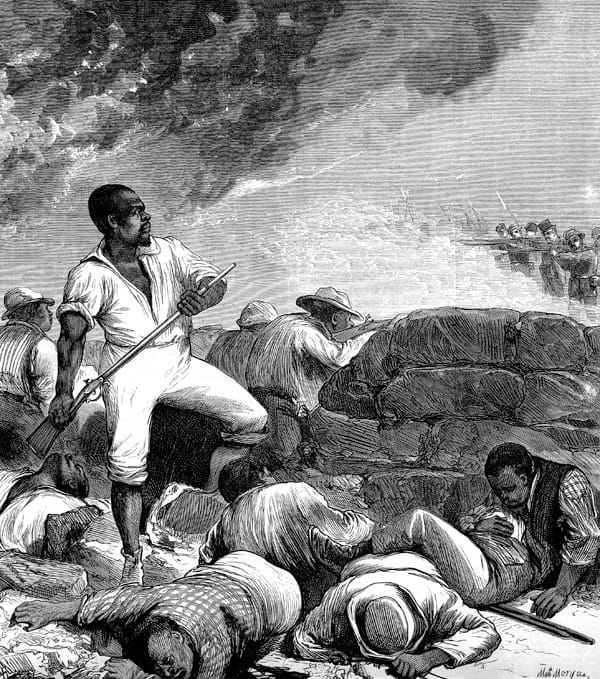
Easter Sunday, 1873. The bloodiest single act of racial violence in Reconstruction. At least 150 Black men murdered, most after they surrendered. Three white men dead. And when it was over, the Supreme Court made sure no one would ever face justice - teaching every white supremacist in the South exactly what they could get away with.
It was a massacre. And it killed more than people - it murdered Reconstruction itself.
The Promise and the Backlash
For a brief moment after the Civil War, Reconstruction offered something radical: Black men could vote, hold office, own land, build lives as citizens instead of property. In Louisiana, freedmen organized militias, ran for office, and participated in a multiracial democracy that terrified white supremacists who'd spent centuries insisting this was impossible.
Grant Parish itself was carved out in 1869 and named after President Ulysses S. Grant. Its seat, Colfax, was named after Grant's vice president. Black citizens outnumbered whites. This was Reconstruction's promise made real - and white Democrats would kill to destroy it.
By 1872, white Southerners had spent years using violence to "redeem" their states from Republican control. Klan terror, assassinations, and massacres were routine. Louisiana's gubernatorial election that November became another battleground in this broader war to overthrow Reconstruction by any means necessary.
Louisiana's 1872 gubernatorial election was a disaster, both sides claiming victory. Republican William Pitt Kellogg said he won. Democrat John McEnery said he won. Two governors. Two sets of officials for every office in the state. In Grant Parish, that meant two sheriffs, two judges, two versions of reality battling for control of the courthouse in Colfax.
The Republicans claimed the offices for Dan Shaw and R.C. Register. The Democrats - calling themselves "Fusionists" - insisted Christopher Columbus Nash (yes, that was his actual name) and Alphonse Cazabat had won. Nash was a Confederate veteran who'd spent eighteen months as a POW. He and his allies weren't about to let Black voters and carpetbaggers steal what they believed was rightfully theirs.
On March 25, the Republicans seized the courthouse. Black militia members, many of them Union veterans, dug trenches and stood guard. They weren't trying to start a war - they were trying to protect the legitimacy of an election. For three weeks, they held the courthouse while tensions mounted across the parish.
Then on April 5, Jesse McKinney, a Black farmer, was shot dead in front of his wife and six-year-old son by white men on horseback. That murder sent hundreds of terrified Black families fleeing to the courthouse for safety, women and children alongside armed men. They knew what was coming.
The Slaughter
Easter Sunday, April 13, 1873. Christopher Columbus Nash led around 150 white men - many of them former Confederate soldiers, members of the Ku Klux Klan and the Knights of the White Camellia - armed with rifles, shotguns, and a small cannon. They surrounded the courthouse where roughly sixty Black defenders waited, outgunned and desperate.
Nash demanded surrender. The defenders refused. Women and children fled. At noon, the white militia attacked.
For two hours, the defenders held. Then the attackers moved their cannon to the undefended riverside rear of the courthouse and opened fire. They forced a Black prisoner at gunpoint to carry a torch to the building and set it ablaze.
Men poured out of the burning courthouse, hands raised, waving white handkerchiefs. The white militia kept firing. Alexander Tillman was shot down as he escaped the flames, his body beaten and his throat slit. Men trying to surrender were gunned down at the courthouse door. Others were chased and shot as they ran.
James West Hadnot, leader of the local Knights of the White Camellia, was hit during the chaos - likely by friendly fire from his own men. His death sent the white militia into a frenzy.
By evening, the shooting had stopped. The surviving Black men were taken prisoner. That night, led by William Cruikshank and Hadnot's sons, the white militia marched their captives out two by two toward a makeshift prison. Then they opened fire at point-blank range, executing at least forty-eight men in cold blood.
Bodies were left in the streets, thrown into the Red River, buried in unmarked graves. Families watched their husbands and fathers murdered. Survivors like Levi Nelson and Benjamin Brim later testified in court, their voices shaking but defiant, describing the executions and the horror.
The death toll was never fully counted. Federal investigators documented at least sixty-two dead, naming eighty-one Black victims. Other estimates ran as high as 150. Only three white men died - two of them apparently shot by their own side.
The Betrayal
US Attorney James Beckwith arrived from New Orleans and indicted ninety-seven white men under the Enforcement Acts of 1870 and 1871, laws designed to protect Black civil rights from Klan violence. Local resistance made arrests nearly impossible. Eventually, nine men stood trial in federal court: William Cruikshank, John Hadnot (brother of the slain James Hadnot), and seven others.
Black witnesses, including women, testified courageously despite threats and intimidation. Three men were convicted in June 1874. Then they appealed.
In 1876, the Supreme Court handed down United States v. Cruikshank. The ruling was devastatingly simple: the Fourteenth Amendment only protected citizens from state actions, not from private violence. The federal government had no authority to prosecute individuals or conspiracies for racial terror. The convictions were overturned. The men walked free.
Louisiana never brought charges. No one was ever punished for the Colfax Massacre.
The Legacy of Blood
The Supreme Court's decision didn't just free the killers - it unleashed a wave of white supremacist violence across the South. In May 1874, Christopher Columbus Nash formed the first chapter of the White League, a paramilitary organization dedicated to "the defense of hereditary civilization and Christianity menaced by a stupid Africanization." Chapters spread like wildfire. Lynchings, voter suppression, and terror became the new normal. Federal troops couldn't intervene. The law said so.
Reconstruction collapsed under the weight of violence the government refused to stop. By 1877, it was over. Jim Crow rose in its place, and the South became what Nash and his allies had always wanted: white-ruled, Black-disenfranchised, unaccountable.
In 1921, white citizens of Colfax erected a monument honoring the three white men who died. It read: "Erected to the memory of the Heroes, Stephen Decatur Parish, James West Hadnot, Sidney Harris, Who fell in the Colfax Riot fighting for White Supremacy."
In 1950, Louisiana put up a highway marker calling it the "Colfax Riot" and claiming it "marked the end of carpetbag misrule in the South." That bullshit lie stood for seventy years until activists finally got it removed in 2021.
On April 13, 2023 - the 150th anniversary - a new memorial was unveiled. It lists fifty-seven confirmed victims by name and acknowledges thirty-six more who were wounded. Reverend Avery Hamilton, whose great-great-great-grandfather was the first Black man killed in the massacre, said it plainly: "People are going to know that their life mattered."
The men who died at Colfax weren't nameless. They were fathers, farmers, Union veterans, neighbors. They believed democracy meant something. They were wrong - or at least, they learned it didn't mean enough to survive contact with men willing to kill for white supremacy and a government unwilling to stop them.
That's the lesson of Colfax: when the law protects murderers instead of victims, terror wins.
Sources
- Eric Foner, Reconstruction: America's Unfinished Revolution, 1863-1877 (Harper & Row, 1988)
- LeeAnna Keith, The Colfax Massacre: The Untold Story of Black Power, White Terror, and the Death of Reconstruction (Oxford University Press, 2008)
- Charles Lane, The Day Freedom Died: The Colfax Massacre, the Supreme Court, and the Betrayal of Reconstruction (Henry Holt and Company, 2008)
- Library of America, "Levi Nelson and Benjamin Brim: The Colfax Massacre Trial"
- Colfax Massacre Memorial Organization
- 64 Parishes, "Colfax Massacre"
- BlackPast.org, "The Colfax Massacre (1873)"