The Detroit Massacre (1943)
The Blame Game
When violence happens in the United States, I want you to look for those casting blame the loudest. I want you to look to those blaming the most vulnerable among us. We have a long and harmful history of lying about the “other” here. We have never faced that honestly. We need to.
That’s exactly what happened in Detroit in the summer of 1943. False rumors lit the match: one claimed a Black man had raped a white woman on Belle Isle, another that whites had killed a Black mother and her baby. None of it was true, but truth didn’t matter. Whites grabbed the lies and ran with them, and the police and press were eager to amplify them. Black Detroiters paid the price.
The Setup
Detroit in 1943 was a city under enormous strain. World War II had transformed it into the Arsenal of Democracy, with auto plants converted to churn out tanks and bombers. Black families migrated north by the tens of thousands, hoping for good wages and a measure of freedom denied in the Jim Crow South. White Detroiters saw those newcomers as competition for jobs and housing. Segregation was enforced by red lines on maps, by union locals that often kept Black workers out, and by police who made clear which side they were on. Federal housing projects sparked protests when Black families moved in. On June 20, nearly 100,000 people crowded onto Belle Isle, the city’s sprawling island park on the Detroit River with beaches and picnic grounds. White Detroiters claimed much of it as their own, while Black families were increasingly present as part of the wartime migration. It was a pressure cooker, sold as patriotic unity on the surface while inequality and racism simmered underneath.
The Violence
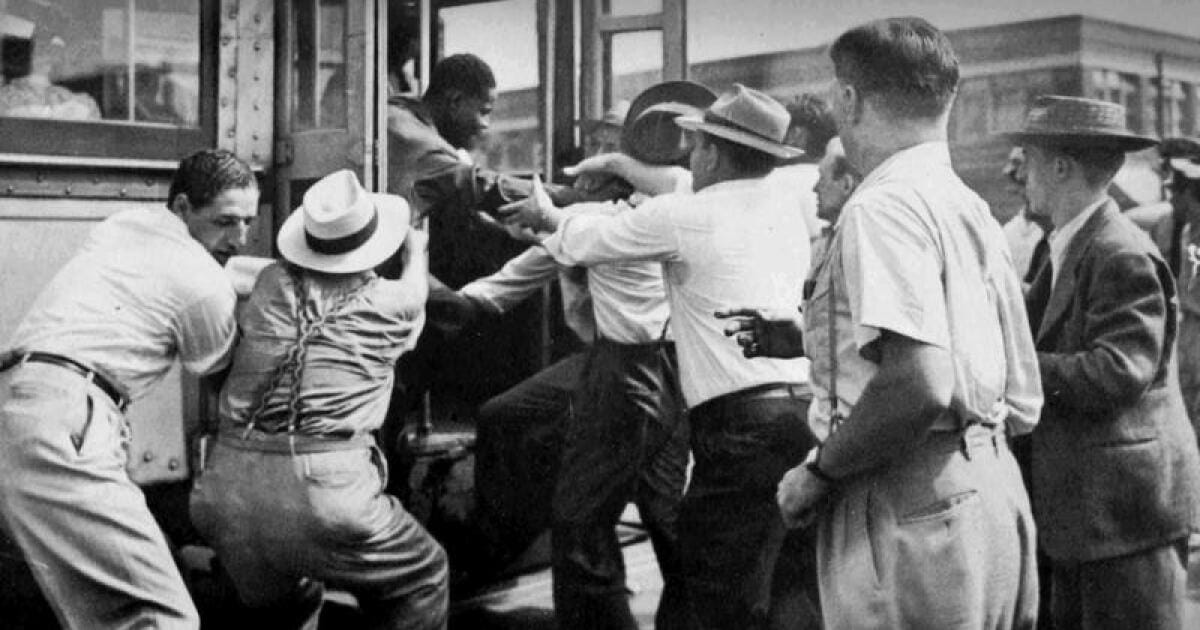
On June 20, fights on Belle Isle spiraled into citywide bloodshed. White mobs dragged Black passengers off streetcars and beat them in the street. Police shot Black men while letting white mobs run wild. Of the 34 people killed, 25 were Black, most of them gunned down by cops. Hundreds more were injured.
The mobs weren’t just local. White workers poured in from nearby neighborhoods and suburbs, some traveling from as far as the Downriver industrial towns, determined to “teach a lesson” to their Black counterparts. The violence was fueled by resentment over jobs in the war plants and lies about supposed assaults that never happened.
We don’t have a full record of every victim. The newspapers erased most of their names, treating them as faceless casualties. We know that many were teenagers, fathers, and mothers, people with families who never made it home. What we are left with are fragments. Accounts of people dragged off streetcars and beaten to death. Reports of men shot in the back by police. Families who never saw their loved ones again. Their humanity was stripped twice, first by the violence and then by the way history recorded it.
The Black Press and the Cover Story
Newspapers and officials had their script ready. They called it a “race riot.” They blamed so-called “Negro hoodlums.” They pretended it was a tragic clash of equals, when in fact it was one side armed with badges and mobs targeting another. The lies gave white Detroit cover and erased the people who were killed.
The city’s Black press told a different story. The Michigan Chronicle documented the beatings, the shootings, the police complicity, and called out the official lies. Its pages recorded what white-owned dailies buried, preserving voices that might otherwise have been lost.
Beyond the Headlines
The mobs weren’t just local thugs. Many were white Southerners who had come north for war jobs, bringing Jim Crow attitudes with them. Months before, white Detroiters had rioted against Black families moving into the Sojourner Truth Homes, a federally built housing project. That attack showed how far white Detroit would go to keep Black residents out. The summer violence carried the same logic to its deadly conclusion.
Black women suffered assaults as they tried to return from work. Teenagers were killed. Families cowered in their homes while police aimed their rifles at them, not at the mobs. Police were not bystanders. They killed more Black residents than the white rioters did.
National leaders reacted cautiously. Federal troops were ordered in, but Roosevelt avoided naming racism as the cause. Eleanor Roosevelt, almost alone among figures of her rank, said plainly that racial prejudice was to blame. For Black Detroiters, the aftermath was more repression and deeper segregation. The wounds lasted for decades.
The Story We Carry
The Detroit Uprising wasn’t an accident. It was the predictable result of lies, scapegoating, and a system that always blamed Black workers when white America felt insecure. The press framed it as chaos. In reality it was organized racial violence, tolerated and fueled by city leaders.
The legacy isn’t hard to find. Look at Chicago, look at Detroit, look at nearly any American city where segregation, redlining, and police violence carved deep lines that remain today. The anger and fear in 1943 weren’t random, they were cultivated. They still are.
Our enemies knew it too. Imperial Japan printed propaganda leaflets calling out American racism, using it to undermine U.S. claims of fighting for freedom abroad. Today it is Russian bot farms and megaphones buying ads and pushing podcasts to weaponize the same divides.
Different century, same trick, new hats.
On the home front of a world war for democracy, Detroit made clear what America was still refusing to confront. This wasn’t just about false rumors or a single night. It was about whether the United States would ever stop blaming the most vulnerable and start telling the truth about itself. So far, we have not.
Sources
- Violence in the Model City: The Cavanagh Administration, Race Relations, and the Detroit Riot of 1967 by Sidney Fine (for broader context and references back to 1943).
- Dominic J. Capeci Jr. & Martha Wilkerson, The Detroit Riot of 1943.
- The Michigan Chronicle archives (Black press coverage of the events).
- Thomas J. Sugrue, The Origins of the Urban Crisis: Race and Inequality in Postwar Detroit.
- “June 1943: Detroit’s Race Riot,” Detroit Historical Society.
- Federal reports on the 1943 Detroit riot (U.S. Office of War Information records).