The Draft Riots, 1863
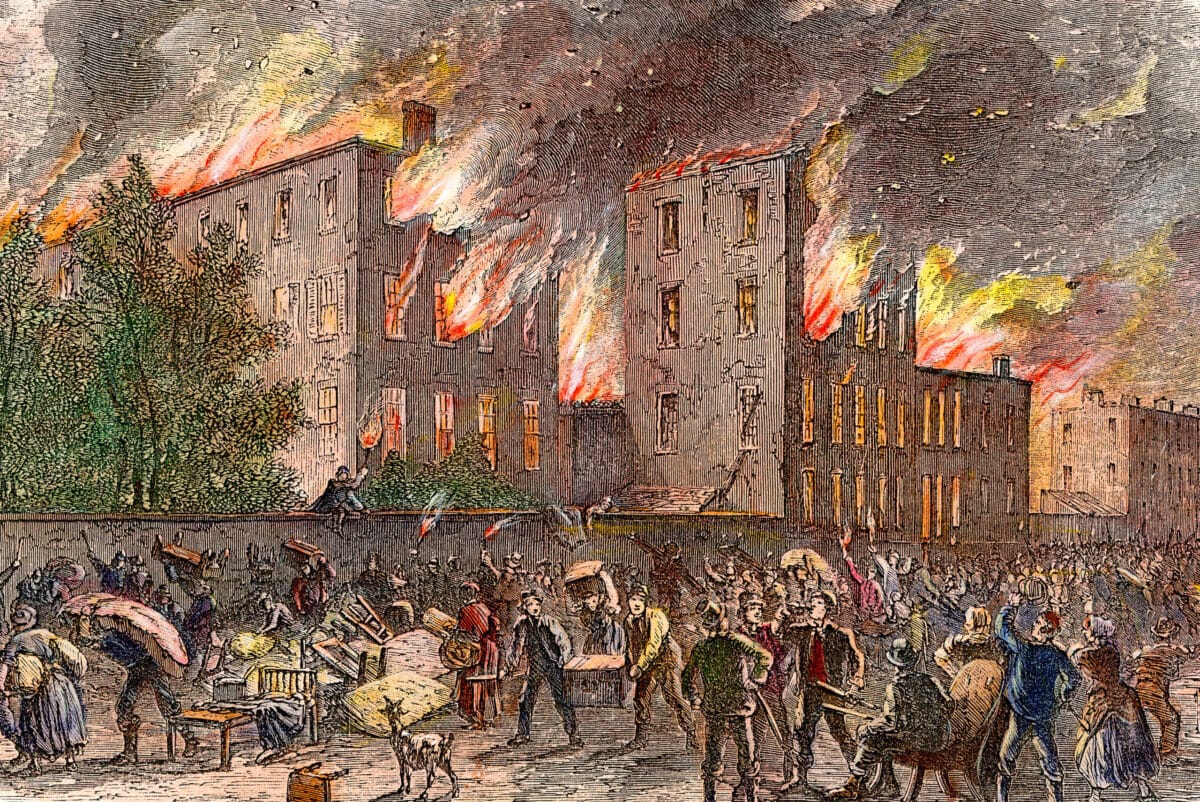
This is one of the stories that started this whole project - learning that the largest urban uprising in American history wasn't some distant frontier conflict or political abstraction. It happened in Manhattan. It lasted four days. And when it was over, Black New Yorkers were hunted, lynched, burned alive in their homes while mobs celebrated in the streets. The official death toll was 119. The real number was probably much higher.
Most people who've even heard of it know the sanitized version - Martin Scorsese's Gangs of New York, where the Draft Riots become a backdrop for white gang warfare, Leo DiCaprio's revenge plot, and Daniel Day-Lewis chewing scenery. The actual victims - the Black New Yorkers who were the primary targets - barely appear. It's historical erasure dressed up as prestige cinema. But the real event was so much more shocking and profound - four days of coordinated racial terror that drove 20 percent of the city's Black population into permanent exile, eleven men and boys lynched and mutilated in the streets, an entire community nearly erased.
The Rich Man's War
By July 1863, the Civil War had gutted the North's enthusiasm for the cause. Two years in, casualties were mounting, and volunteers weren't signing up anymore. So Congress passed the Enrollment Act - the first federal draft in American history. Every man between 20 and 45 had his name thrown into a lottery. If your number came up, you went to war.
Unless you had $300.
That was a year's wages for the average working man. It was pocket change for New York's merchant class. The message was clear: poor men fight, rich men pay.
The war itself was a mess of contradictions. The Confederacy was fighting to preserve slavery - that part was never in doubt. But the Union? Lincoln had promised he wasn't fighting to end slavery, just to preserve the Union. New York's economy was built on Southern cotton. The city's merchants and bankers had grown rich off the slave trade long after it was supposedly illegal. When the war started, there was even talk of New York seceding alongside the South.
This was the North. This was Lincoln's Union. And it was rotten with racism and complicity.
For Black New Yorkers, none of this was abstract. They'd been competing with Irish immigrants for dock work and low-wage jobs for years, facing violence and discrimination from both employers and fellow workers. In March 1863, white longshoremen had already rioted and attacked 200 Black workers. The city had a long history of anti-Black violence - this wasn't new territory.
Then came the Emancipation Proclamation in January 1863. Lincoln made it official: this was now a war to end slavery. For many white working-class New Yorkers, especially Irish immigrants who'd been sold a different story, it felt like a betrayal. Democratic newspapers stoked that rage for months, warning that freed slaves would flood north and steal jobs. It was a calculated lie designed to weaponize economic anxiety into racial violence.
Black men couldn't even be drafted. They weren't considered citizens.
The city's Democratic newspapers stoked the rage for months, warning that freed slaves would flood north and steal jobs, that white workers were being sacrificed for Black freedom. It was a lie designed to weaponize economic anxiety into racial violence. And it worked.
Four Days of Blood
On July 13, the second day of the draft lottery, a mob of about 500 men - led by volunteer firemen from Engine Company 33, the "Black Joke" (named after a type of sailing vessel, not their ethnicity - they were white) - stormed the draft office at Third Avenue and 47th Street. They smashed the lottery wheel, torched the building, and cut telegraph lines to isolate the city from federal help. Within hours, thousands joined them. What started as a protest against conscription became a pogrom.
The mobs didn't just attack symbols of power. They hunted people. Black New Yorkers were dragged from their homes, beaten in the streets, lynched from lampposts and trees, their bodies set on fire while crowds cheered. Eleven Black men and boys were hanged over four days.
Abraham Franklin was 23, a disabled coachman who supported his mother. When the riots started, he rushed to her home to pray for her safety. He knelt beside her and asked God to protect her. Minutes later, the mob broke down the door, beat him bloody, and hanged him in front of her. When soldiers arrived and cut him down, he was still alive. They left to fight another mob. The rioters returned, hung him again, and mutilated his body while it dangled.
Peter Heuston, 63, was a widowed Mohawk veteran of the Mexican War with an eight-year-old daughter. The mob saw his dark skin, assumed he was Black, and beat him to death near the docks. His daughter became an orphan.
William Jones was so badly mutilated that witnesses couldn't identify him - only the loaf of bread still clutched under his arm told them who he'd been.
The mob burned the Colored Orphan Asylum on Fifth Avenue, a symbol of Black achievement and white charity. Over 200 children were inside. Staff evacuated them minutes before the building went up in flames, the crowd looting everything they could carry before torching what remained. The message was clear: erase Black people from the city entirely.
White abolitionists, interracial couples, and anyone who employed Black workers became targets too. The docks, where Black and white longshoremen competed for wages, turned into a war zone. Businesses that catered to Black customers were destroyed. Entire neighborhoods were emptied.
The Reckoning That Never Came
By July 16, federal troops fresh from Gettysburg arrived and opened fire on the mobs. Order was restored with bayonets and bullets. The draft resumed a month later without incident. The wealthy paid their commutation fees. The poor went to war.
And the people who led the massacre? Nothing. One man, John Andrews, a lawyer who gave an anti-draft speech outside the draft office, was convicted of treason and sentenced to three years hard labor. That's it. No one was charged for the lynchings, the murders, the arson of the Colored Orphan Asylum - nothing. The rest went home. No mass arrests. No trials. No justice.
Lincoln sent the troops to stop the riots. He never sent anyone to prosecute the murderers. The federal government that could mobilize thousands of soldiers in days couldn't be bothered to hold a single lynching trial. The message was clear: Black lives could be defended when it served Union interests, but never avenged.
New York's Black population dropped by 20 percent in the aftermath, the lowest it had been since the 1820s. Families fled or were driven out. Those who stayed moved to the edges of the city, away from white neighborhoods, seeking safety that never fully came.
The riots, as usual, were blamed on the victims. Newspapers called it a "race riot," as if Black New Yorkers had started it. The lie stuck for generations. Textbooks barely mentioned it. When they did, they framed it as understandable rage over an unfair draft, not as the racist massacre it was.
Even when the story finally got attention, it got whitewashed. Scorsese's film turned the massacre into entertainment, a gritty period piece where the actual victims disappear into the margins of someone else's story - a white man's story.
Manhattan has over 800 historical markers. Not one commemorates the victims. One hundred and sixty-two years... barely an acknowledgment outside of academia and occasionally ham-handed pop culture.
The Draft Riots proved something ugly: that Northern racism could be just as murderous as Southern slavery, that working-class solidarity could be shattered along racial lines, and that the state would let white mobs murder Black citizens without consequence. The message echoed for decades - in Tulsa, in Rosewood, in East St. Louis, in every place where white America decided Black lives were expendable.
Sources
- Iver Bernstein, The New York City Draft Riots: Their Significance for American Society and Politics in the Age of the Civil War (1990)
- Leslie M. Harris, In the Shadow of Slavery: African Americans in New York City, 1626-1863 (2003)
- Barnet Schecter, The Devil's Own Work: The Civil War Draft Riots and the Fight to Reconstruct America (2005)
- Report of the Committee of Merchants for the Relief of Colored People Suffering from the Late Riots in the City of New York (1863)
- Heather Ann Thompson and various historians, New York Times coverage (2021, 2025)