The Great Southwest Railroad Strike of 1886
From Victory to Disaster
In 1885, the Knights of Labor pulled off the unthinkable during the Wabash Railroad strike. They beat Jay Gould, the most ruthless railroad baron in America. When Gould’s Wabash system tried to crush a walkout, solidarity strikes rippled across his empire. The disruption was so powerful that Gould blinked, handed back wages, reinstated fired men, and agreed to arbitration. It was a stunning win. Membership in the Knights exploded. For one brief year, American workers believed they had a fighting chance against monopoly capital.
But Gould wasn’t done. He was waiting.
Who Were the Knights?
The Knights of Labor weren’t just another union. They were the first mass labor movement in the United States, growing from a small fraternal order in 1869 to nearly 700,000 members by the mid-1880s. Their vision stretched beyond wages and hours. They pushed for the eight-hour day, equal pay for women, worker cooperatives, and a society less dominated by monopoly capital. On paper they were inclusive, open to immigrants, Black and white workers, women as well as men, and both skilled and unskilled laborers. Women like Leonora Barry rose as leaders, and Black assemblies flourished across the South.
But they were far from perfect. They excluded Chinese workers outright, embracing the same racism that fueled the Chinese Exclusion Act. Some local assemblies refused to admit Black workers or segregated them into separate lodges. Skilled workers sometimes resented standing alongside unskilled laborers, and tensions between those groups never went away. The Knights looked radical compared to what came before, but they also carried the prejudices of their time. They were a movement of contradictions—broad and visionary, but messy and flawed in practice.
The Spark
In March 1886, ten Knights of Labor men were fired for union activity on Gould’s Southwestern railroads. That blatant attack on the right to organize set off an explosion. More than 200,000 workers walked off the job. This wasn’t a small skirmish. It stretched from Texas through Arkansas, Kansas, and Missouri, with solidarity actions across the country. Workers weren’t just striking for pay, they were striking for the right to exist as a union. The St. Louis Post-Dispatchwrote that Gould’s system had been “brought nearly to a halt by a single order of the Knights.”
Gould’s Revenge
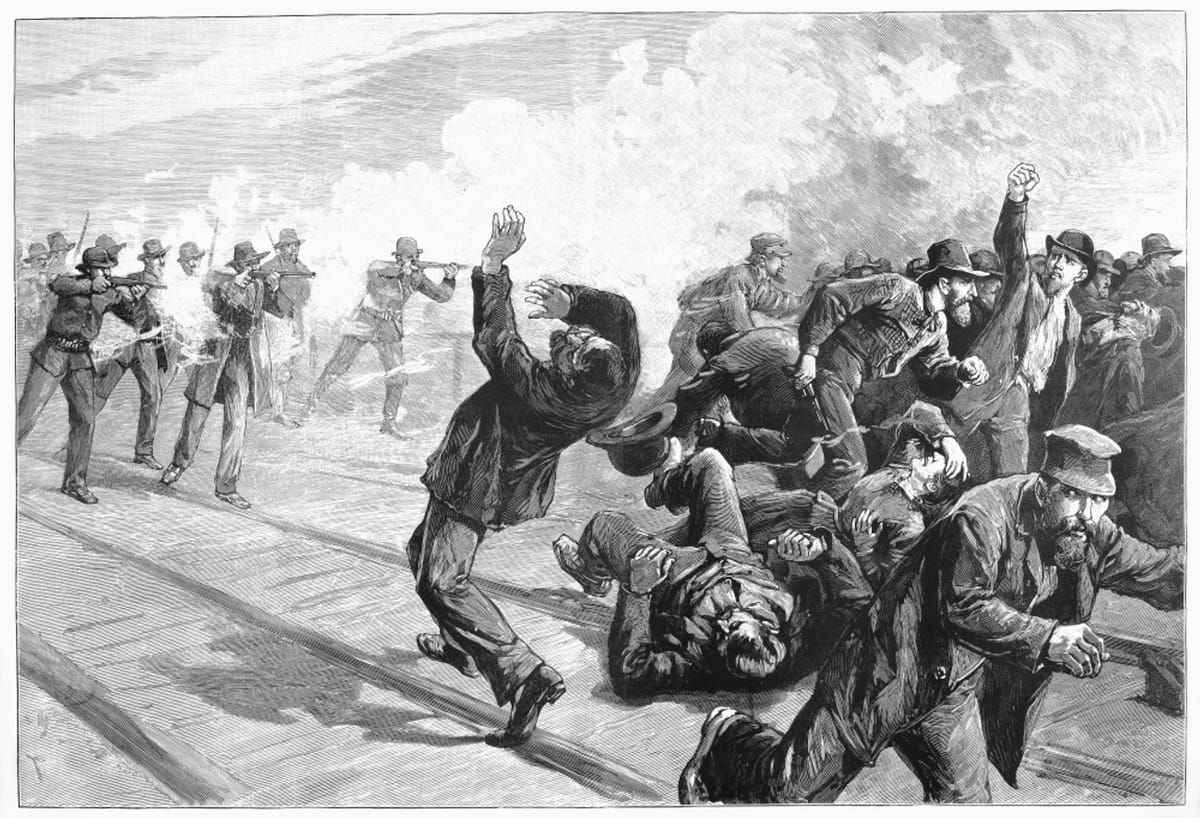
Rail yards turned into battle zones. Deputies and strikebreakers, many of them armed, clashed with picketers. Troops were deployed. In Fort Worth, a striker named Charles Hunt was shot dead by deputies. In St. Louis, militias broke up crowds with rifles and bayonets. Railroad cars burned. Gould’s hired guns and state forces worked hand in hand to break the strike. At least ten people were killed. Hundreds more were beaten, jailed, or blacklisted. The Chicago Tribune dismissed the dead and wounded as “rioters” and praised the power of the state. Gould himself stayed calm and aloof, publicly confident that the state would side with him. He was right.
The People
Jay Gould sneered: “I can hire one half of the working class to kill the other half.” In 1886, he made good on the threat. Bosses are still doing it today.
Terence Powderly, head of the Knights, preached cooperation and nonviolence. Against Gould’s onslaught, his strategy collapsed. On the ground, Martin Irons, a machinist from Texas and chair of District Assembly 101, became the face of the strike. He organized mass walkouts, held rallies, and tried to keep the movement alive as Gould and the militias bore down. When the strike failed, Irons was blacklisted and died in poverty, punished for daring to lead. The Fort Worth Gazette blasted Irons as reckless, claiming he had “dragged honest men into ruin.”
The rank and file were immigrants, Black and white, men and women, the most inclusive labor movement the United States had yet seen. They fought not just for wages, but for dignity in a country where bosses bought governors and newspapers alike. Families cooked for strikers, marched in support, and endured the terror of raids and evictions. This wasn’t an abstract battle of capital and labor. It was flesh and blood, neighbors standing together, and in some cases, dying together.
Collapse
By May, the strike was starved out. Troops and deputies kept the trains running. Hundreds of workers were blacklisted. Gould’s empire rolled on. The Knights, once nearly 700,000 strong, began to crumble. Within a few years they were finished, swept aside by the craft unions of the AFL, narrower and less radical, but less vulnerable to the kind of all-out war Gould had waged. The Kansas City Times congratulated the authorities that “order has been restored,” while the wreckage of lives and livelihoods was quietly ignored.
What It Left Behind
The fall of the Knights wasn’t just a defeat. It was a turning point. Gould’s victory sent a clear message: capital and the state would crush industrial solidarity with bullets, blacklists, and lies. A year earlier the Knights had shown that workers could win. In 1886, they learned how fast that dream could be destroyed. Two months later, the Haymarket Affair in Chicago deepened the blow, cementing 1886 as one of the darkest years for organized labor in America.
Sources
- Terence Powderly, Thirty Years of Labor (1889)
- Richard Schneirov, Labor and Urban Politics: Class Conflict and the Origins of Modern Liberalism in Chicago, 1864–97 (1998)
- Robin Einhorn, Property Rules: Political Economy in Chicago, 1833–1872 (2001)
- Robert Weir, Beyond Labor’s Veil: The Culture of the Knights of Labor (1996)
- Leon Fink, Workingmen’s Democracy: The Knights of Labor and American Politics (1983)
- Contemporary reporting in the St. Louis Post-Dispatch, Chicago Tribune, Fort Worth Gazette, and Kansas City Times (1886)