The McKees Rocks Massacre: 1909
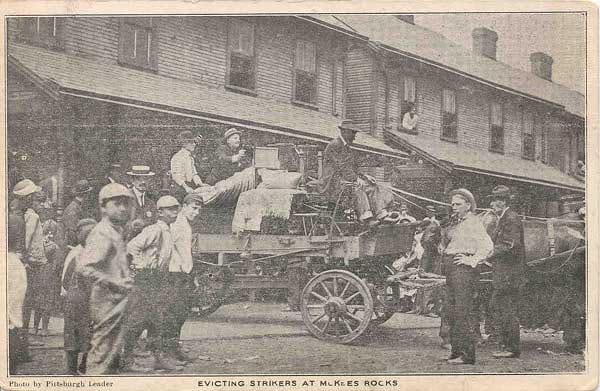
The Slaughterhouse
McKees Rocks, Pennsylvania, 1909. The Pressed Steel Car Company was known by another name in town: The Slaughterhouse. Workers called it that because going to the job meant getting skinned alive. Mostly immigrants - Hungarian, Slovak, Polish, Italian - they lived in company-owned housing, paid company rent, and bought at inflated prices from company stores. Wages were skimmed by crooked labor bosses. Men were killed in accidents so often their families joked grimly about who’d be next. It wasn’t a factory. It was a machine for grinding people down.
The Strike
In August 1909, the workers had enough. Five thousand walked out, demanding higher pay and an end to the skimming and cheating. They were unarmed, but the company didn’t care. Pressed Steel Car brought in strikebreakers, hired guards, and called on the Pennsylvania state constabulary, the “Cossacks,” infamous for cracking immigrant skulls with sabers. Families joined the picket lines, children marched with their parents, whole neighborhoods stood in defiance.
August 22, 1909
It was a Sunday when the killing came. Thousands gathered near the plant. State troopers and company guards opened fire. Rifles cracked, sabers swung, and the crowd scattered in terror. At least a dozen strikers and family members were killed, some shot in the back as they ran. Dozens more were wounded. Among the dead were women and children. One reporter wrote that the streets looked like a battlefield, blood soaking into the dirt outside the factory gates.
Debs Arrives
Eugene V. Debs, the socialist firebrand already hated by bosses nationwide, came to McKees Rocks within days. He didn’t organize the strike, it belonged to the immigrant workers themselves, but he gave it a voice the whole country could hear. He called the constabulary hired killers, denounced the company’s fortress, and told the men and women of McKees Rocks that their fight was the fight of every worker in America. His presence drew national headlines, infuriated the bosses, and reminded strikers they weren’t alone.
Aftermath
The strike dragged on into September. Nearly 200 wounded, more than a dozen dead, thousands still on edge. Pressed Steel Car never recognized the union, but it did grant modest wage increases and cut back the worst abuses of the labor bosses. It wasn’t victory, but it wasn’t total defeat. The blood at McKees Rocks forced change, even if the price was unbearable.
Aftermath & Accountability
The killings were so shocking that Congress held hearings in 1910. Immigrant workers testified about wage skimming, filthy housing, and the brutality of the company’s private enforcers. The Pressed Steel Car Company denied everything, blaming “foreign agitators” and pointing to Debs as the problem. The Pennsylvania constabulary faced no punishment for firing on unarmed crowds. No executives went to prison. No one paid damages to the families who buried their dead. The hearings embarrassed the bosses, but accountability never came.
Why It Matters
McKees Rocks was extraordinary even in an age of massacres. It showed the scale of violence companies and the state would unleash to keep immigrant workers in line. It showed how headlines branded immigrant strikers as dangerous radicals while their children bled in the street. And it showed how solidarity could stretch across languages and borders when workers called the factory by its real name: The Slaughterhouse.
What happened at McKees Rocks wasn’t chaos and it sure as hell wasn’t an accident. It was the Slaughterhouse brought into the open, with state troopers slashing at unarmed families and company guards turning a town into a killing ground. The bosses went home safe. The workers went home bloody. That’s the American labor story in one ugly snapshot.
Sources
- Philip S. Foner, History of the Labor Movement in the United States, Volume 4: The Industrial Workers of the World, 1905–1917. International Publishers, 1965.
- Paul Krause, The Battle for Homestead, 1880–1892. University of Pittsburgh Press, 1992. (Context on Pennsylvania labor struggles).
- Congressional Record, Hearings before the Committee on Labor, House of Representatives, 61st Congress, 2nd Session, 1910 (Testimony on McKees Rocks strike).
- David Montgomery, The Fall of the House of Labor. Cambridge University Press, 1987.
- “Troops Fire Into Crowd at McKees Rocks,” New York Times, August 23, 1909.
- John P. Enyeart, The Quest for "Just and Pure Law": Rocky Mountain Workers and American Social Democracy, 1870–1920. Stanford University Press, 2009. (On Debs and socialist involvement).