The Memorial Day Massacre (1937)
America in 1937
By 1937, American workers had been through hell and back. The Great Depression had wrecked lives. The 1934 Textile Strike had seen workers across the South crushed by police and National Guard. Just months earlier, in Flint, Michigan, auto workers had seized GM plants in a sit-down strike and forced the company to recognize the United Auto Workers. The Wagner Act of 1935 had promised workers the legal right to organize, but in steel towns, that promise was a joke. The “Little Steel” companies, led by Republic Steel, had no intention of recognizing unions.
The Spark
On May 30, Memorial Day, 1937, striking steelworkers and their families marched toward the Republic Steel plant on Chicago’s South Side. About 1,500 people turned out, men, women, and kids, many carrying American flags and union banners. They weren’t armed. They were demanding the same thing workers in Flint had won: recognition and a fair contract.
The Massacre
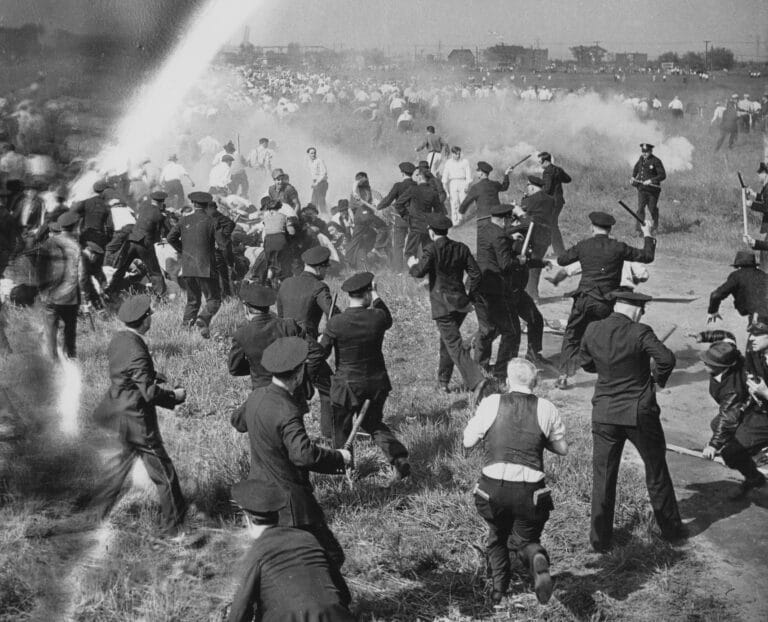
Police met them at the plant gates. When the marchers refused to turn back, the cops opened fire. Ten people were killed, most shot in the back as they ran. More than thirty were shot and nearly ninety people were wounded overall. Victims included Joe Rothmund, Lee Tisdale, and Earl Handley, ordinary men who wanted nothing more radical than a union card and a fair shake. Reporters on the scene described cops chasing marchers, clubbing them, even shooting people already on the ground. Families ran for cover through the smoke and chaos. Memorial Day became the day police gunned down American workers.
The Cover-Up
Chicago authorities and Republic Steel’s PR machine wasted no time. Papers called the march a “riot.” Police claimed they were under attack. For weeks, the official story was that “radicals” had provoked violence. Those were lies. Then newsreel footage surfaced during Senate hearings, stark, undeniable film of cops firing into a fleeing crowd. The cover-up cracked, but accountability never came. Republic Steel carried on. The strike was broken.
The Story We Carry
The massacre showed how fragile workers’ “rights” were when police lined up with the bosses. Flint had proved that workers could win if they held on. Chicago showed the cost when police and company power decided to crush a movement outright. On a day meant to honor the dead of America’s wars, ten steelworkers joined their ranks, killed not by foreign armies but by their own city’s cops.
The Textile Strike of ’34, the Sit-Down at Flint, and the Memorial Day Massacre of ’37, three chapters in the same story. Workers demanding dignity, bosses calling in the state, and blood spilled on American soil. This is labor history. It’s American history. And it’s a reminder: the fight for basic rights was never peaceful, never inevitable, and never granted without a struggle.
Sources
- Illinois Labor History Society. Memorial Day Massacre of 1937 (primary overview).
- Congressional Hearings before the Senate Committee on Education and Labor, 1937 (La Follette Civil Liberties Committee).
- Chicago History Museum. Memorial Day Massacre of 1937: Photographs and Newsreels.
- Warren, Wilson J. Struggling with “Inevitability”: Republic Steel, Unionization, and the Memorial Day Massacre of 1937. Labor History, 1998.
- Brecher, Jeremy. Strike! (rev. ed., 2014).
- New York Times, June 1–3, 1937 (coverage of the shootings and aftermath).
- Chicago Tribune, June 1937 (contemporaneous coverage and editorial stance).