The Ocoee Massacre, 1920
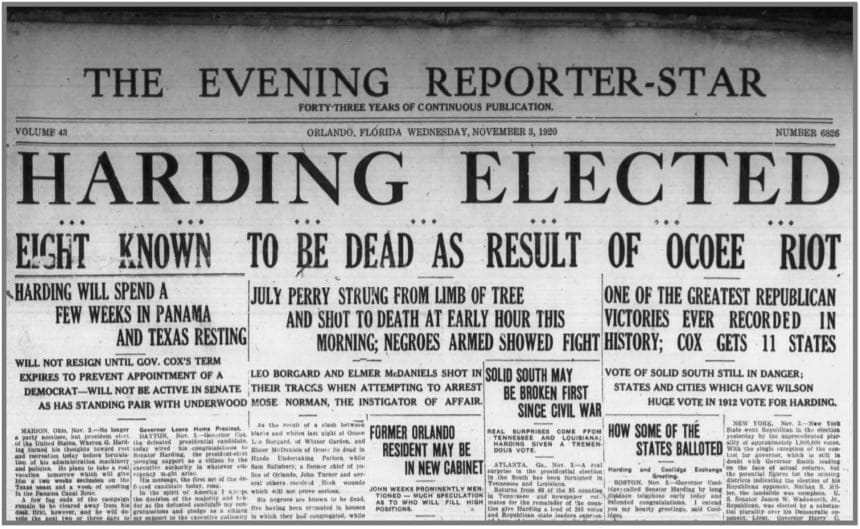
November 2, 1920. Election Day. Mose Norman, a Black citrus farmer in Ocoee, Florida, tried to vote. White poll workers turned him away. He came back. They beat him with his own shotgun and chased him off.
That night, white mobs murdered between 30 and 60 Black residents, burned 25 homes, torched two churches, and drove every single Black person out of town. The exact death toll will never be known. White participants took body parts as souvenirs.
This was the bloodiest day of election violence in American history. And it wasn't isolated.
The Big Picture
The 1920 election terrified white supremacists across the South. It was the first election where women could vote - where white women got a right Black men were being murdered for trying to exercise. The first after WWI where Black veterans came home expecting the rights they'd fought for.
White men had always voted freely. White women just gained that right. But Black men and women trying to do the same? That got you killed.
The Klan's response was coordinated and national. They marched through Orlando, Jacksonville, Daytona, Miami - hundreds strong in each city. The night before the election, Klansmen paraded through Ocoee with megaphones: "Not a single Negro will be permitted to vote." In Jacksonville that same day, over 4,000 Black voters stood in line while armed whites prowled. Across the South, polling places became kill zones.
What Happened
July Perry was Ocoee's Black community leader - a deacon, a labor broker, prosperous enough that anyone wanting to hire Black workers had to go through him. He and Mose Norman had been registering Black voters, paying poll taxes for those who couldn't afford them.
When Norman got beaten at the polls, he fled to Perry's house. By 9 PM, about 100 armed white men surrounded it, led by Sam Salisbury - former Orlando police chief, KKK member. When Perry answered the door, Salisbury grabbed him. Perry's 22-year-old daughter Coretha pointed a rifle. Salisbury shoved it aside. Gunfire erupted.
Two white men died. Salisbury took a bullet. July and Coretha Perry were wounded.
The mob retreated and called for backup. Fifty carloads arrived with Gatling guns.
They burned Perry's house, then systematically torched Black neighborhoods. Families fled through swamps carrying children, chased by gunfire, navigating by the light of their burning homes. The killing continued until nearly 5 AM.
July Perry was found at dawn, arrested, seized by a mob while being transferred to jail. They beat him, hanged him from a telephone pole, and shot his corpse. His body was left swinging as a warning.
Mose Norman escaped north and never came back.
The Theft
The KKK blockaded Ocoee for a week. Black residents who survived were given an ultimatum: leave or die. Those offered compensation were forced to sell land for pennies. One family got $10 for 37 acres.
July Perry's family tried to recover his estate. The court-appointed administrator never provided an accounting. The deed was amended: "It is further agreed that the herein named property cannot be sold to or otherwise conveyed to a negro."
By 1930, Ocoee had 1,180 whites and 2 Black residents. An entire community - 255 people - erased. The land they'd owned is now worth at least $10 million.
The Cover-Up
NAACP investigator Walter White arrived days later. White residents were "still giddy with victory." The United Confederate Veterans rescheduled their convention so attendees could tour Ocoee and celebrate.
The U.S. Department of Justice found "no attempt to intimidate any Negroes." A Florida grand jury found "no evidence" against anyone.
No one was arrested. Sam Salisbury bragged about his role for the rest of his life. He later served two terms as mayor of Ocoee.
The Pattern
This wasn't Southern pathology. It was American policy. The same year saw massacres across the South. Tulsa came next year. Rosewood two years after. The federal government watched Black communities burn and did nothing.
Every Black community learned the lesson - vote and die, with no protection, no justice, no consequences for your killers.
In 2018, Ocoee acknowledged the massacre. In 2020, Florida required it be taught in schools.
Then in 2023, Governor Ron DeSantis's administration rewrote the standards. Now teachers must describe Ocoee as "acts of violence perpetrated against and by African Americans." Both-sides language for a massacre. Same treatment for Tulsa and Rosewood.
Stephen Nunn, July Perry's great-grandson, watched his ancestor's lynching get reframed as mutual violence. The state that drove out every Black resident now forces teachers to lie about why.
The echoes are loud. A century after Ocoee, on January 6, 2021, a mob stormed the Capitol to overturn an election - waving the same flags and symbols the Klan carried. The methods evolved but the goal stayed the same: use violence to decide who votes and whose votes count.
The modern right's platform increasingly centers on the same two pillars that drove the violence in 1920: ethnic resentment and vote suppression. They're just better at hiding it behind bureaucratic language and education standards.
When people can't win democratically, they turn to violence. When no one holds them accountable, they do it again. And when they finally get called out, they rewrite the textbooks.
Sources
- Paul Ortiz, Emancipation Betrayed: The Hidden History of Black Organizing and White Violence in Florida from Reconstruction to the Bloody Election of 1920, University of California Press, 2006
- "Yesterday, This Was Home: The Ocoee Massacre of 1920," Orange County Regional History Center, 2020
- Florida OPPAGA, "Ocoee Election Day Violence - November 1920," Report No. 19-15, 2019
- Equal Justice Initiative, "Lynching in America: Confronting the Legacy of Racial Terror," 2017
- TIME, "Florida Approves Controversial Guidelines for Black History," July 2023
- Zinn Education Project, "The Ocoee Massacre"