The Ponce Massacre, 1937
Right now, lots of right-wing Americans are losing their minds because Bad Bunny - a Puerto Rican - is headlining the Super Bowl. MAGA's calling for ICE raids at the halftime show. One former NFL player said if Bad Bunny doesn't like America, he should "keep his ass in Puerto Rico." Marjorie Taylor Greene wants English declared the official language before the game. The ignorance is staggering, but it's not new.
The fact that this needs to be said at all is a fucking embarrassment, but here we are: Puerto Ricans are Americans. U.S. citizens since 1917 - conveniently granted citizenship just in time to draft them for World War I. But Puerto Rico isn't a state. It's a colony. Seized from Spain in 1898. Puerto Ricans can't vote for president, have no real representation in Congress. They're Americans when we need soldiers, but not when they want rights.
Extraction Economics
By 1937, Puerto Rico had been under U.S. control for nearly 40 years. American corporations owned the sugar industry - the land, the economy, the wages. Puerto Ricans worked the fields for pennies while American executives got rich. The Great Depression made it worse.
The independence movement wasn't about flags and anthems. It was about survival. About who controlled Puerto Rico's resources, who benefited from Puerto Rican labor, whether Puerto Ricans would have any say in their own future. The Nationalist Party, led by Pedro Albizu Campos, saw American colonialism for what it was: extraction. Take the sugar, take the profits, leave Puerto Ricans with scraps.
In 1934, Albizu led a strike that shut down the sugar industry and forced wages from 45 cents to $1.75 per 12-hour day. That's why the empire wanted him gone. Not because he was radical. Because he was effective.
In 1937, independence supporters tried to march in Ponce. Peacefully. Families. Palm fronds. No weapons. But the empire was already at war with them. Police had massacred four Nationalists in 1935. Two Nationalists assassinated the police chief in retaliation in 1936, were executed without trial. By March 1937, the U.S.-appointed governor decided to end it. He ordered the massacre.
The Man Who Gave the Order
Franklin Roosevelt appointed Blanton Winship as Puerto Rico's governor in 1934. That's how colonies work - the president picks your leader. Winship was a general with a decorated war record, former Judge Advocate General. He knew the law cold. He just didn't give a damn about it when Puerto Ricans wanted freedom.
His police chief was E. Francis Riggs, fresh from Nicaragua where he'd been "advising" dictator Anastasio Somoza and helping hunt down Augusto César Sandino, the rebel fighting U.S. occupation. When the empire needed muscle in Puerto Rico, they sent the guy who'd already crushed one independence movement. See the pattern?
Together they militarized the island's police. Machine guns. Riot gear. Military boot camps. Preparing to shoot Americans - because by 1937, that's what Puerto Ricans were.
The target was Pedro Albizu Campos and the Nationalist Party. In 1934, Albizu led a strike that paralyzed U.S. sugar corporations and quadrupled workers' wages. The first jury - mostly Puerto Ricans - refused to convict him on sedition charges. Winship's people empaneled a new jury: 10 North Americans, 2 Puerto Ricans. Conviction secured. Albizu went to federal prison.
The Trap
The Nationalists planned a march for March 21, 1937 - the anniversary of Puerto Rico abolishing slavery under Spanish rule in 1873. They'd commemorate that freedom and demand Albizu's release. They requested a permit from Ponce's mayor. He granted it. Legally, they didn't even need one, but they asked anyway.
Winship found out. He ordered Police Chief Colonel Enrique de Orbeta to revoke it. Last minute. No appeal. "Stop this demonstration by all means necessary."
They marched anyway.
The Killing
About 200 police surrounded Marina and Aurora streets. The Insular Police - Puerto Ricans under the command of U.S.-appointed officers. Neighbors shooting neighbors on orders from the colonial governor. Chief Guillermo Soldevilla and 14 men blocked the front. Chief Perez Segarra and Sergeant Rafael Molina commanded nine with Thompson submachine guns in back. Chief Antonio Bernardi and 11 machine gunners took the east. Another dozen with rifles covered the west.
The marchers - men, women, children, all unarmed - walked into a kill box.
Palm Sunday. People in Sunday clothes. Families carrying palm fronds. La Borinqueña started playing. The Cadets of the Republic began to march. A shot. Iván Rodríguez Figueras dropped dead.
Then the police opened fire from every direction. Thirteen minutes of sustained shooting. Machine guns ripping through bodies. People running, every exit blocked.
An 18-year-old at a window, shot through the head. A boy on a bicycle, killed in the street. Seven-year-old Georgina Maldonado running for the church, shot in the back. The flag-bearer fell. Carmen Fernández, a young girl, grabbed the flag. Shot and gravely wounded.
Bolívar Márquez Telechea, 27, dragged himself to a wall. With his own blood: "¡Viva la República! ¡Abajo los Asesinos!" Then he died.
Most were shot in the back while fleeing. Police chased them into homes and beat them. Final count: 19 civilians dead - 17 men, one woman, one child. Two officers also killed by their own colleagues' wild firing. More than 200 wounded.
Not one civilian was armed.
The Lie
Colonel de Orbeta arrived after the shooting. He grabbed a photographer. Staged heroic shots - officers scanning rooftops for snipers, posing around dead cops. Newspapers printed them. The story: Nationalists started it.
Winship ordered the prosecutor to arrest more Nationalists, file no charges against police. Rafael Pérez Marchand resigned rather than participate. The government investigation concluded nothing. Indicted no one.
But Carlos Torres Morales of El Imparcial had captured the truth. Senator Luis Muñoz Marín traveled to Ponce, examined the unpublished photos, wrote to Interior: the pictures showed police shooting terrified people running for their lives.
The Investigation
The American Civil Liberties Union sent Arthur Garfield Hays to lead an independent investigation. After 10 days, the commission presented findings to 30,000 people at Plaza Baldorioty and the University of Puerto Rico.
Massacre. Police acted as a mob. Winship directly responsible. The Nationalists were exercising their constitutional rights.
Newspapers printed Bolívar Márquez's blood message on front pages. Twenty thousand mourners attended funerals. Congressmen Vito Marcantonio and John Bernard denounced Winship on the House floor.
In 1939, Roosevelt removed Winship. No charges. No trial. No consequences. He retired comfortably. No police officer prosecuted. No commander faced trial. The grand jury closed without indicting anyone.
Names and Lives
Iván G. Rodríguez Figueras was the first to fall. He went to a march and became the opening shot in a massacre.
Bolívar Márquez Telechea was 27, married to Emilia Rivera. As he bled out, he dragged himself to a wall and used his own blood to write a message: "¡Viva la República! ¡Abajo los Asesinos!" - Long live the Republic! Down with the Murderers! It became the rallying cry. Newspapers across Puerto Rico printed it on their front pages. Twenty thousand mourners saw it. The empire wanted to erase what happened. Bolívar made sure they couldn't.
Seven-year-old Georgina Maldonado was a child. She was running toward a church.
María Hernández del Rosario was the only woman killed. Obdulio Rosario was carrying a palm leaf crucifix. Juan Delgado Cotal Nieves, Luis Jiménez Morales, Caferino Loyola Pérez, Ramón Ortíz Toro, Ulpiano Perea, Juan Antonio Pietrantoni, Juan Reyes Rivera, Conrado Rivera López, Jénaro Rodríguez Méndez, Pedro Juan Rodríguez Rivera, Eusebio Sánchez Pérez, Juan Santos Ortíz, Juan Torres Gregory, Teodoro Vélez Torres.
They were fathers, sons, brothers, neighbors. They went to commemorate freedom and never came home.
What It Means
The Ponce Massacre is the largest massacre in U.S. colonial history in Puerto Rico. Terror works. The message was clear: this is what happens when you challenge American power. That fear - the legacy of state violence - still shapes Puerto Rican politics today.
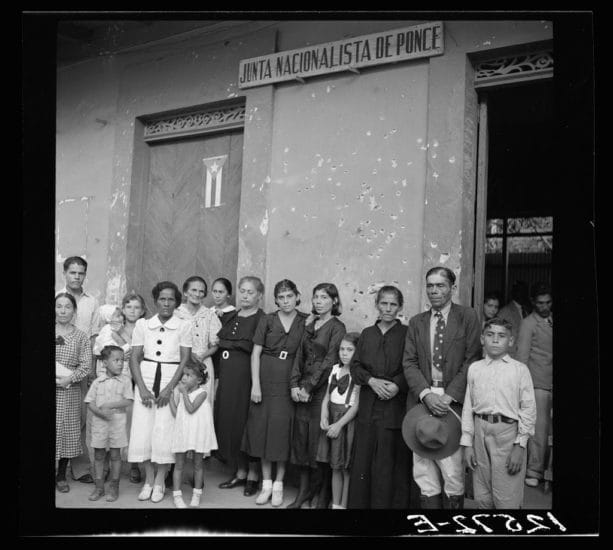
Machine gun bullet holes still scar the walls at Marina and Aurora. The old Nationalist headquarters is now the Museo de la Masacre de Ponce, a U.S. National Historic Place. Inside: photographs, artifacts, testimonies. Outside: a plaque for those "who offered their lives in defense of their ideals." Every March 21, Puerto Ricans commemorate the massacre. In 1971, more than 7,000 Young Lords marched in the Bronx to remember. More on that group later in this project. A lot more.
No apology. No admission. Just a museum where soldiers murdered children for waving a flag and palm fronds.
So when Puerto Rico's in the news - hurricane, earthquake, crisis - and Americans act confused about why we should help, or when they lose their minds over Bad Bunny at the Super Bowl, remember: Puerto Ricans are U.S. citizens. When they demanded the rights every other American takes for granted, we sent machine guns. On a Sunday. On Palm Sunday.
We did this to our own citizens. And we've never apologized. Puerto Ricans have been Americans for over a century. They're not visitors. They're not foreigners. They're us.
Sources
- American Civil Liberties Union Hays Commission Report (1937)
- Nelson A. Denis, War Against All Puerto Ricans: Revolution and Terror in America's Colony (2015)
- Juan González, Harvest of Empire: A History of Latinos in America (2000)
- José E. Ayoroa Santaliz, Museo Casa de la Masacre de Ponce (2011)
- Congressional Record, April 14, 1937, page 4499
- University of Puerto Rico, Centro de Investigaciones Históricas
- Carlos Torres Morales photographic archive, El Imparcial
- Library of Congress, Farm Security Administration Collection