The Rosewood Massacre (1923)
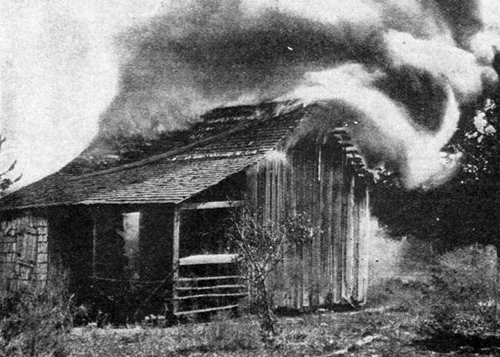
Rosewood, Florida was the kind of place Jim Crow wasn't supposed to allow. Black families owned land - some up to 300 acres. Two-story homes with pianos and parlors. A thriving community of around 200 people who ran their own businesses, taught in their own school, and lived without asking permission from white folks. The Goins brothers operated a successful turpentine company. Families had wealth, stability, and something rare in 1923 Florida: hope.
That should've been the story. Instead, a white woman lied, and an entire town was erased from the map.
The Pattern
Rosewood was not unique. It was part of a deliberate pattern stretching back decades - the systematic destruction of Black prosperity in America. Wilmington, North Carolina in 1898: a white supremacist coup overthrew the elected government and massacred the Black community. Tulsa's Greenwood District in 1921: white mobs burned "Black Wall Street" to the ground. Whenever Black Americans built wealth, white violence followed.
The formula was always the same. Find a thriving Black community. Wait for a spark - usually a white woman's accusation. Then destroy everything: homes, businesses, churches, schools. Steal the land. Erase it from memory. This is how white supremacy worked. Not through law alone, but through terror that made law irrelevant.
A Lie Built on a System
New Year's Day 1923. Fannie Taylor, 22 years old and white, showed up at a neighbor's house bruised and beaten. She claimed a Black man had assaulted her. Her husband James, a mill foreman, believed her. So did every white man in Sumner and the surrounding counties, because that's what the system trained them to do.
But Sarah Carrier, a Black woman from Rosewood who worked as Taylor's housekeeper, told a different story to her family. She'd been at Taylor's house that morning with her granddaughter Philomena Goins. They saw a white man leave through the back door before noon. Carrier knew what had happened - Taylor's white lover had beaten her, and she needed someone to blame. The Black community in Rosewood knew the truth. It didn't matter.
This wasn't happening in a vacuum. Florida led the nation in lynchings of Black men. Just weeks before, in Perry, whites had burned Charles Wright at the stake and torched the Black community's school, church, and homes. A KKK rally had just wrapped up in Gainesville. White men in Florida were looking for excuses to kill Black people and destroy Black prosperity. Taylor handed them one.
The Hunting Begins
Sheriff Robert Elias Walker got bloodhounds. The dogs led a mob to Aaron Carrier's home on the edge of Rosewood. They dragged him behind a car for three miles, nearly killing him. Walker intervened and got him to protective custody in Gainesville, but the mob wasn't satisfied.
On January 2, they found Sam Carter, a Black craftsman. They tortured him, demanding to know where Jesse Hunter - an escaped convict Taylor's husband had decided was the attacker - was hiding. Carter couldn't tell them what he didn't know. They shot him in the face and lynched his body from a tree.
The mob kept coming. They were hunting for a phantom, but what they really wanted was blood.
Sarah and Sylvester Make a Stand
By January 4, the mob descended on the home of Sarah Carrier - the woman who knew Fannie Taylor's secret. Her house was full of people seeking refuge, including children hiding upstairs under mattresses, visiting their grandmother for Christmas.
Sarah's son Sylvester Carrier was there too. He was known in Rosewood simply as "Man" - a crack shot, expert hunter, and music teacher. White folks thought he was arrogant because he didn't bow and scrape. When the mob showed up demanding entry, they shot the family dog. Sarah came to the porch. They shot her dead on her own doorstep.
Sylvester returned fire. He killed two white men - C.P. "Poly" Wilkerson and Henry Andrews - and wounded four others before he was killed. The children escaped into the swamps during a lull in the gunfire. For hours, a Black man had held off a white mob. That couldn't stand.
The Extermination
Word spread that Black residents had killed white men. Hundreds of whites poured in from surrounding counties. Some came from out of state. The Ku Klux Klan showed up in force.
For three days - January 5 through 7 - they systematically destroyed Rosewood. They burned every Black home and business to the ground. They shot people on sight. Lexie Gordon, a light-skinned Black woman too ill to flee, was murdered. Mingo Williams was killed 20 miles outside town. James Carrier, who had one arm and had been hiding in the swamps, emerged to bury his mother Sarah and brother Sylvester. The mob forced him to dig his own grave, then lynched him and buried him next to them.
Women and children fled into the freezing swamps in their nightclothes and waited for days. John Wright, the white store owner, hid Black residents in his house. On January 6, two white train conductors - brothers John and William Bryce - drove their train slowly through Rosewood, blowing the horn and evacuating women and children (no men allowed) to Gainesville, Archer, and other towns. The Gainesville Black community took them in, families housing five or six refugees each.
By January 7, Rosewood was ash and bodies. The official death toll was eight - six Black residents, two white attackers. Survivors said it was closer to 30 or 40. Some estimates went as high as 150. No one will ever know the real number.
The Aftermath That Wasn't
Governor Cary Hardee knew what was happening. He offered to send the National Guard. Sheriff Walker declined, claiming he had it under control. The governor went hunting instead.
A grand jury convened in February 1923. They heard from 13 witnesses. Their conclusion: insufficient evidence to prosecute. No one was ever charged. Not one arrest. The records have been lost.
White men bought the survivors' land for three dollars an acre under obvious duress in May 1923, then resold it for ten dollars an acre. They profited off the massacre. The families lost everything - homes, land, wealth, community, safety. Many survivors changed their names and never spoke of Rosewood again, terrified that white people would track them down. Minnie Lee Langley kept the story from her own children for 60 years.
Rosewood disappeared from maps, from newspapers, from memory. The only structure left standing was John Wright's home. Cedar Key went from 37.7 percent Black to zero percent by 1996.
Seventy Years of Silence, Then the Reckoning
In 1982, investigative reporter Gary Moore from the St. Petersburg Times stumbled onto the story and convinced survivors to break their silence. It took immense courage. Arnett Doctor - whose mother survived the massacre - led descendants in demanding recognition and restitution. The work of bringing Rosewood back from erasure fell to Black historians and activists who refused to let it stay buried.
The Florida Legislature commissioned a team of historians - led by Dr. Maxine D. Jones from Florida State University, working with colleagues from Florida A&M and the University of Florida - to document what happened. Their 100-page report in 1993, built on survivor testimony and painstaking research, made it impossible to deny the truth. Survivors came forward, now in their 80s and 90s. CBS's 60 Minutes aired a report in 1983.
In 1994, Florida passed House Bill 591, the Rosewood Bill. Nine survivors received $150,000 each - about $2.1 million total. It was the first time a legislative body in the United States paid reparations to Black Americans for racist violence. It wasn't enough. It wasn't justice. But it was something.
John Singleton's 1997 film Rosewood brought the massacre to a wider audience, though it took liberties with the facts (adding a fictional hero played by Ving Rhames). Survivors and historian Gary Moore criticized the Hollywood treatment, but the film did what decades of silence couldn't - it put Rosewood back into public consciousness. The work of telling the truth, however imperfectly, mattered.
No apology for the killers who walked free. No accountability for the governor who went hunting while a town burned. Just money, seven decades too late, for the handful who lived long enough to see it.
The state designated the site a Florida Heritage Landmark in 2004. A historical marker now sits on State Road 24, where a thriving Black community once stood.
Sources
- Maxine D. Jones et al., "A Documented History of the Incident Which Occurred at Rosewood, Florida, in January 1923" (Florida Board of Regents, December 1993)
- R. Thomas Dye, "Rosewood, Florida: The Destruction of an African American Community," The Historian, Vol. 58, No. 3 (1996)
- Gary Moore, Rosewood: The Full Story (Manatial Press, 2015)
- Edward González-Tennant, "Intersectional Violence, New Media, and the 1923 Rosewood Pogrom," Fire!!!, Vol. 1, No. 2 (2012)
- Equal Justice Initiative, "On Jan 05, 1923: White Mob Destroys Black Community of Rosewood, Florida"