The Seattle General Strike, 1919
Not Blood, but Fear
Today’s post is a little different than most. Usually, we’re talking about blood on the streets, pogroms, massacres, lynchings... the worst America has to offer. Seattle in 1919 shows another path: what it looks like when working people shut it all down without a single shot fired. I lived in Seattle for 28 years, and in all that time this strike was never taught in schools, never memorialized, barely mentioned at all.
The Walkout
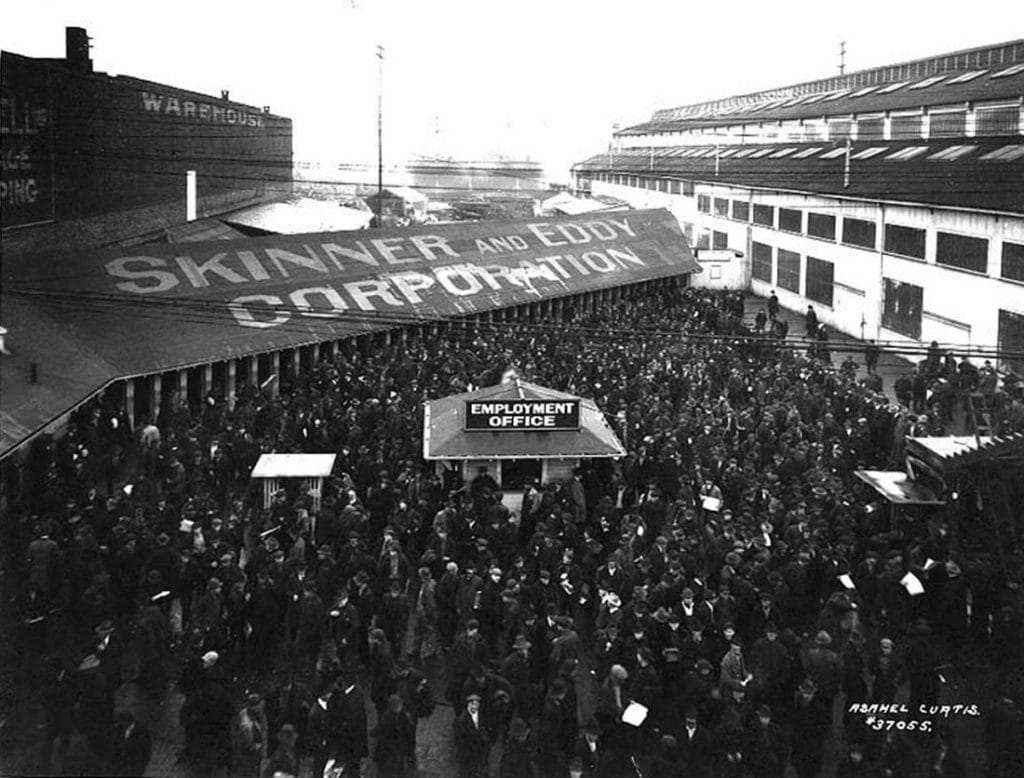
On February 6, 1919, more than 65,000 workers walked out in solidarity with shipyard workers demanding better pay. But this wasn’t just one trade. Waiters, streetcar drivers, telephone operators, laundry workers, cooks, barbers… across the city, people put down their tools. Seattle didn’t descend into chaos. The strike committee kept milk deliveries going, garbage collected, and hospitals supplied.
This wasn’t an isolated strike. The nation was in turmoil after World War I, with inflation gutting wages and soldiers returning home to no jobs. Across the country, massive strikes erupted in steel, coal, and textiles. Globally, revolutions and uprisings were shaking old empires. Seattle’s strike was part of that larger wave, a glimpse of worldwide unrest and possibility. They proved they could run the city better than the bosses.
Ordinary people organized kitchens to feed tens of thousands of strikers and their families. Strikers with armbands patrolled the streets to keep order. There were no riots. No looting. The city was quiet, except for the silence of work stopped.
But it wasn’t perfect solidarity. Seattle’s labor movement, like much of the country, excluded Black and Asian workers from many unions. The same strike that showed the promise of worker control also revealed the fault lines of racism that kept workers divided.
The Panic
That terrified the powerful more than broken windows ever could. Mayor Ole Hanson, a lawyer and real estate man with political ambitions, thundered that it was a Bolshevik conspiracy. He painted himself as the last line of defense against revolution. Within days, nearly 1,500 federal troops were stationed in Seattle, and the governor had the National Guard on alert. Soldiers with machine guns were posted at key points in the city. The message was clear: order would be restored at gunpoint if needed.
The Seattle Times blared that “Reds plot to seize city.” It was nonsense, but effective. Across the country, the strike was painted as treason. The first Red Scare was in full swing, and Seattle became Exhibit A.
If this script sounds familiar, it should. In 2020, politicians and pundits claimed Seattle had been burned by rioters and “taken over by anarchists.” It hadn’t. The same old trick was replayed a century later: invent chaos, sow panic, and justify a crackdown on people who dared to govern themselves.
Voices of the Strike
Anna Louise Strong captured the stillness of those days with her famous line: “Nothing moved but the tide.”
She wasn’t just a reporter. She was the daughter of a minister, educated at Oberlin and the University of Chicago, and had become a fierce advocate for workers. As an editor at the Seattle Union Record, the city’s labor-owned paper, she gave voice to the strike with bold, unapologetic words. She wrote that “Labor will feed the people. Labor will care for the babies and the sick. Labor will preserve order… labor will stay on the job of making the city run for the benefit of all.” Her editorials framed the strike not as disorder but as a glimpse of a new kind of order, built from the ground up by workers themselves.
Women were at the heart of the strike too. Telephone operators, laundry workers, and cooks all joined in. Strike kitchens fed tens of thousands, staffed by women who kept families alive while men patrolled the streets. Their work rarely made the headlines, but without them the strike would have collapsed.
The strike committee, made up of rank-and-file delegates from dozens of unions, became a shadow city government. They debated how to distribute food, keep the peace, and show the country what solidarity looked like. For a brief moment, it worked.
That should also sound familiar. In 2020, when peaceful protesters demanding police reduction and calling for human rights in Seattle set up the Capitol Hill Autonomous Zone (CHAZ), they too organized kitchens, community safety patrols, and mutual aid. Different neighborhoods a century apart, downtown and shipyards then, Capitol Hill later, same smear playbook. The people trying to change the world for the better were smeared as anarchists and demonized as a threat. The same script, a century apart.
The Aftermath
The 1919 strike lasted five days. Facing threats of martial law, and with national union leaders refusing support, the Central Labor Council folded, under threats of martial law and with national union leaders hanging them out to dry. The American Federation of Labor wanted no part of a strike that could be branded “radical.”
Mayor Hanson strutted as if he had defeated a revolution. He cashed in on the panic, publishing books and hitting the lecture circuit as the man who “saved Seattle” from Bolshevism.
The truth? There was no insurrection, no armed workers rising up. The only guns in the streets were in the hands of the government, thousands of them, pointed at the people. Just workers proving they didn’t need bosses to run their lives. That was enough to terrify the ruling class.
The long-term fallout was brutal. Employers across the Pacific Northwest seized the moment to launch an “open shop” campaign, meaning workplaces where union membership wasn’t required. In practice it was union-busting by another name, breaking unions and rolling back labor power. Seattle’s labor movement, once one of the strongest in the country, was left scarred. For decades, the strike was dragged out as a cautionary tale: this is what happens when you step too far out of line.
The Story We Carry
The Seattle General Strike was crushed not by failure, but by fear. Not a single person died, yet the reaction was as fierce as if a war had broken out. The ruling class understood something important: order without them is more dangerous than any riot.
For five days, workers glimpsed another way of living. That’s why the papers lied. That’s why troops rolled in. Not because of what happened in Seattle, but because of what it meant.
Sources
- Anna Louise Strong, editorials in the Seattle Union Record (1919)
- Robert L. Friedheim, The Seattle General Strike (1964)
- Jeremy Brecher, Strike! (1972, updated editions)
- Cal Winslow, Radical Seattle: The General Strike of 1919 (2019)
- William Millikan, A Union Against Unions: The Minneapolis Citizens Alliance and Its Fight Against Organized Labor, 1903–1947 (2001) [for open shop context]
- Primary documents collected in the University of Washington’s Labor Archives of Washington