The Straw Hat Riots, 1910-1925
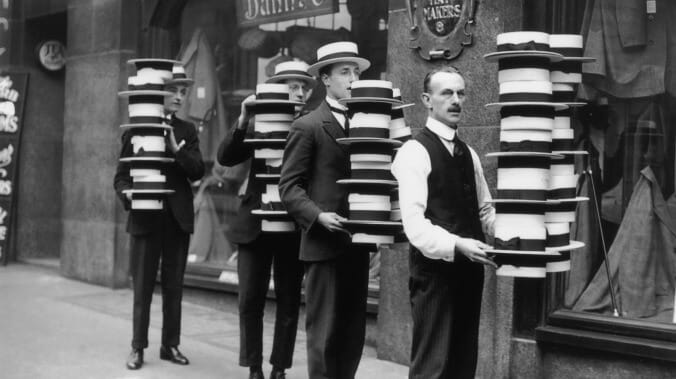
This one came to me from a reader - and is now one of my favorite examples of people just going banana-pants bonkers over class, othering anything that sticks out, and how mob violence spreads. Turns out this wasn't one riot. It was a pattern. Fifteen years of escalating violence across multiple cities over goddamn hats. This one is much deeper than the absurd nature would suggest. Buckle up, this gets weird.
When Fashion Became a Recurring Street War
Your hat wasn't an accessory in early 20th century America. It was your public face, announcing your status before you opened your mouth. Every man wore one, everywhere, always. A decent straw boater cost serious money - $2 to $15 in 1922 dollars, which translates to roughly $35-$250 today. For men making less than a dollar an hour, that was a week's wages or more. Show up anywhere bareheaded and you'd failed as a man.
The seasonal hat code came straight from Edwardian society: straw from May 15 to September 15, felt the rest of the year. No exceptions. Men's straw hats were supposed to disappear on September 15 - "Felt Hat Day." Not because of weather. Not because of logic. Just because some arbitrary social code said so.
On Wall Street, stockbrokers made a game of it, playfully smashing each other's hats in what they thought was harmless fraternity hijinks. Elite "bro culture" before we had a name for it. Newspapers ran annual warnings as the date approached. The whole thing was stupid, but it was their stupid, and everyone went along with it.
Then it spread. And mutated. And year after year, the violence got worse.
Pittsburgh, 1910: First Blood
The day after Felt Hat Day in 1910, a mob of men and boys came down Pittsburgh's Penn Avenue and began pulling off straw hats and smashing them. They climbed onto trolley cars to destroy hats. They stopped cars to smash drivers' hats. Fights spilled into the streets.
The police were summoned. They responded, but not effectively. Reports from the Pittsburgh Press noted that cops "enjoyed watching the mayhem."
The Press tried to sound the alarm: "It is all right for stock brokers on the exchanges to destroy one another's hats if they like, on the principle that everything goes among friends. But no man likes to have his hat snatched from his head by somebody he has not yet been introduced to."
The warning went unheeded.
Bridgeton, New Jersey, 1912: The Fire Hoses Come Out
Two years later, the same thing happened in Bridgeton. Hats were destroyed. Eyes were blackened as hat wearers fought back. Street brawling spread. Some men tried to escape into stores but were pursued.
The police tried stopping the fights but there weren't enough of them.
So the fire department was called out. Order was restored by hosing down the rioters.
Harlem, 1919: It Turns Deadly
The year 1919 was particularly bad for racial tensions in American cities - the Red Summer saw race riots and massacres across the country. And that's when the straw hat tradition intersected with America's original sin.
A riot began in New York's Harlem after a white man's straw hat was grabbed and destroyed. Then a white plainclothes police officer had his hat knocked off as he descended subway stairs. He tried to arrest his assailant, but an angry crowd surrounded him, shouting "lynch him, lynch him."
The officer fired his gun. He killed the man he'd tried to arrest and wounded another. The cop was knocked to the ground and only saved through the intervention of a Black New York officer in uniform.
It's thought that a man died in the ensuing melee.
This was 1919. The Red Summer. Twenty-six cities witnessing racial massacres. Black veterans returning from France to find Jim Crow waiting for them. A stupid tradition about hats didn't cause that violence - but it gave it an excuse.
New York City, 1922: Eight Days of Chaos
But the biggest riot came on September 13, 1922 - two days before the sacred deadline. This time, the kids didn't even wait for Felt Hat Day.
Gangs of teenagers stormed through Manhattan's Mulberry Bend neighborhood, ripping straw hats off factory workers' heads and stomping them into the pavement. Mulberry Bend - the rotting heart of the old Five Points slum, predominantly Italian immigrant, desperately poor. The kind of place where police might look the other way.
When the workers fought back, it wasn't cute anymore. The brawl spread to the docks, where longshoremen weren't about to let some punk kids destroy property they couldn't afford to replace. Traffic stopped on the Manhattan Bridge as hundreds of men threw punches over goddamn hats.
The next night, the attacks escalated into something resembling urban warfare. Mobs of teenagers - some estimates said a thousand strong - prowled Amsterdam Avenue armed with sticks, many with nails driven through the ends specifically designed to hook hats off men's heads. They lined up along streetcar tracks, snatching hats from passengers as the cars rolled by. They hid in doorways and ambushed pedestrians. Anyone who resisted got beaten.
This was exclusively male violence. Boys and young men targeting adult men. Women wore straw hats too, but they were never touched. This wasn't about fashion compliance - it was about masculine social control, about young men without power finding someone they could dominate.
Harry Gerber, 25, was kicked and stomped so badly he needed hospitalization. Acting Detective Sergeant Brindizi had his hat thrown into the street, chased after the gang that took it, and was tripped - he went headlong into the gutter. Even off-duty cops weren't safe. E.C. Jones reported seeing a mob of about a thousand rampaging through the Upper West Side. The gutters filled with crushed straw.
The police response? Slow. Inadequate. In some precincts, almost amused. When they did make arrests, the punishment was a joke: fines, maybe a day or two in jail. Seven boys under 15 got spanked by their fathers at the police station and sent home.
By September 15 - the actual deadline - whole blocks were under siege. The New York Times reported that "in some cases, mobs of hundreds of boys and young men terrorized whole blocks." Police were completely overwhelmed. Break up a gang in one neighborhood, and they'd just reform somewhere else.
And here's what nobody was saying out loud but everyone understood: this was about more than hats. The Times had declared that wearing a straw hat out of season marked you as "a Bolshevik, a communal enemy, a potential subverter of the social order." This was 1922, right in the middle of the First Red Scare. Non-conformity meant disloyalty. Wearing the wrong hat meant you didn't respect American values.
Magistrate Peter A. Hatting (yes, really - Hatting) tried to restore order, declaring that "a man has a right to wear [a straw hat] in a January snowstorm if he wishes." The longest sentence was three days, served by A. Silverman. Seven boys under 15 avoided arrest entirely - Lieutenant Lennahan at the East 104th Street precinct summoned their fathers and ordered them to spank their sons right there.
Hat shops stayed open late to accommodate the panicked men desperate to replace their destroyed headwear. Destroying someone's hat was destroying their ability to be respectable in public. It was symbolic castration that also cost them money they didn't have. The violence worked precisely because the stakes were so high.
The riots finally burned out after eight days of chaos, dozens of injuries, and countless arrests.
1924: Murder
The violence didn't stop. In 1924, a man was murdered for wearing a straw hat.
We don't know his name. We don't know where it happened. The historical record gives us nothing but the bare fact: someone died. Murdered. Over a hat.
That absence of detail is its own kind of horror. His death wasn't important enough to document. Just another casualty of a stupid tradition that wouldn't die.
The Pattern
This wasn't an isolated incident. It was a pattern that escalated over fifteen years, with newspapers warning each year that it would get worse - and each year, it did.
The tradition started as stockbroker hijinks - wealthy white men playfully destroying each other's hats because they could afford to buy new ones. But the kids who took to the streets weren't stockbrokers. The arrest records tell the story: working-class immigrant names, not a single one from an Episcopal parish register. These were teenagers from families that had fled pogroms and poverty, attacking factory workers and dock workers - men just slightly above them on the economic ladder.
And they were teenagers in a new sense. The decades before 1922 had seen brutal fights to end child labor. The Triangle Shirtwaist Fire of 1911 had killed 146 garment workers. New York finally passed laws making it illegal to employ children under 14. The rioters were literally the first generation it was illegal to put to work. Bored, idle, with no economic role but plenty of aggression, they found purpose in violently enforcing arbitrary rules they had no stake in creating.
These were boys too young to have fought in the Great War. They'd watched older men come back from France as heroes while they stayed home. They couldn't prove their masculinity in combat, so they proved it by dominating other men in the street. Displaced aggression with a Victorian rulebook as justification.
The 1919 Harlem riot shows how this pattern could intersect with America's deepest wounds. A stupid tradition about hats became a flashpoint for racial violence during the worst period of racial terror since Reconstruction. The straw hat was just the match. The kindling was already there.
This is the pattern: elites establish a stupid custom among themselves. It filters down through society. The powerless adopt it with deadly seriousness, using it as permission to attack anyone who steps out of line. They weren't defending their own interests - they were enforcing someone else's social hierarchy. That's what made it so vicious.
How It Finally Died
The tradition finally died not because anyone learned a lesson, but because the violence became too extreme to ignore. In 1925, President Calvin Coolidge wore a straw hat past September 15, and the New York Times put it on the front page: "Discard Date for Straw Hats Ignored by President Coolidge." After that, hat-snatching became less frequent and eventually disappeared.
By 1929, straw boaters had become symbols of the frivolous excess of the Roaring Twenties - outdated relics of an era America wanted to forget after the crash. The hats disappeared, and with them, the excuse for violence.
What's wild is how thoroughly we've sanitized this story. It gets retold as a quirky historical footnote, a "can you believe people cared about that?" curiosity. But fifteen years of escalating mob violence across multiple cities over fashion compliance should tell us something about what happens when arbitrary social codes are enforced with violence and backed by the excuse that "everybody knows the rule."
The men who beat Harry Gerber, the cop who shot a man over a hat in Harlem, whoever murdered that man in 1924 - they weren't defending anything real. They were just angry and given permission by tradition to hurt someone. That's all it takes.
Sources
- "City Has Wild Night of Straw Hat Riots," New York Times, September 16, 1922
- "Straw Hat Smashing Orgy Bares Heads from Battery to Bronx," New York Tribune, September 16, 1922
- "Straw Hat Riots," Pittsburgh Press, September 15, 1910
- "The Straw Hat Riots Come to a Head," Saturday Evening Post, September 16, 2024
- David Zucchino, "The 1922 Straw Hat Riot Was One of the Weirdest Crime Sprees in American History," Slate, April 2013
- New York Public Library, "100 Years Ago Men and Boys Fought on the Streets of New York Over Wearing Straw Hats Past Summer," September 2022
- Harlem World Magazine, "When Straw Hats Sparked Street Battles: The Wild 1922 Riots That Shook Harlem And New York," September 2025
- Katrina Gulliver, "Hat Havoc in the Big Apple," Law & Liberty, September 2022