The Textile Workers' Strike of 1934
The Biggest Strike You’ve Never Heard Of
In the fall of 1934, more than 400,000 textile workers walked off the job. It was the largest strike in U.S. history up to that point, bigger than anything in steel, coal, or railroads. Entire mill towns across the South and New England shut down. Women walked out of the mills, men joined them on the picket lines, kids and grandparents marched in support. For three weeks, the American textile industry ground to a halt.
And yet, you probably never learned about it. That silence is the point. The strike terrified the bosses and embarrassed the New Deal. It showed the raw power of working people, and the ruthless lengths the state and industry would go to crush them.
The National Context
The Great Depression had left millions jobless, and those still working were being squeezed harder than ever. Roosevelt’s New Deal raised hopes among workers that the federal government might finally be on their side. Section 7(a) of the National Industrial Recovery Act, passed in 1933, seemed to promise workers the right to organize. Union membership surged overnight. Textile workers, most of them poor, many of them women, thought their moment had come.
But the bosses had their own answer: the “stretch-out.” Fewer workers forced to run more machines, paid the same or less. Twelve-hour shifts became the norm, wages stayed low, and entire families had to work just to keep food on the table. Mill villages kept them under the company’s thumb: the houses, the stores, even the schools all belonged to the boss.
The Spark
By summer 1934, workers had had enough. The United Textile Workers called a general strike for September, but what happened quickly spun beyond official control. Within days, the walkout spread across the country — from New England’s old mill towns to the deep South. Entire mills emptied out. Streets filled with processions of workers carrying handmade banners. And the strike spread not because of union officers, but because of “flying squadrons” — rank-and-file groups, many of them women, who traveled from town to town convincing others to join. The rebellion was self-organized, led by ordinary workers who refused to take one more day of stretch-out misery.
The Crackdown
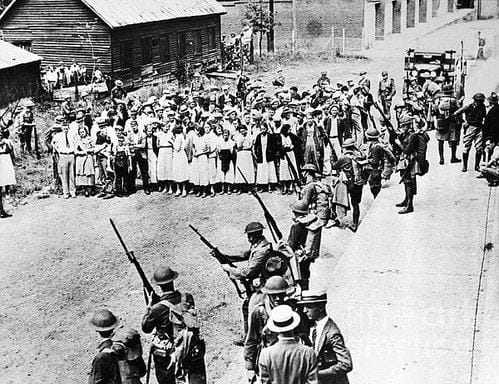
The state responded as if facing an armed invasion. Governors declared martial law. In South Carolina alone, 15,000 National Guardsmen were deployed. Armored cars rolled through mill villages. Machine guns were mounted at mill gates. Planes flew overhead to intimidate crowds. In North and South Carolina, strikers were shot point-blank. By the time it was over, around 20 workers were dead and thousands more were jailed.
In Georgia, Governor Eugene Talmadge went further than anyone: he rounded up strikers by the hundreds and locked them in Fort Oglethorpe, a World War I internment camp ringed with barbed wire. Officials and newspapers preferred to call it a “fairground stockade,” a euphemism meant to dull the horror. The reality was clear: the state was treating its own citizens like enemy soldiers. Families were penned in overcrowded stockades with inadequate provisions, a deliberate show of force meant to break the strike and terrify anyone who thought about resisting.
The North wasn’t spared either. In Rhode Island, Massachusetts, and Maine, governors mobilized the National Guard and police to break up mass pickets. In Woonsocket, Rhode Island, clashes left workers beaten and at least one dead, with hundreds arrested. Courts issued sweeping injunctions against picketing, and troops patrolled mill gates as if the towns were occupied territory.
FDR’s Silence
Franklin Roosevelt’s silence during the strike was deafening. Workers had convinced themselves that the New Deal would be on their side, but when governors unleashed troops and locked strikers in stockades, the White House looked away. Roosevelt never condemned the violence. He refused to pick a side, afraid of angering Southern Democrats who enforced segregation and Northern industrialists whose support he needed for recovery programs.
Call it what it was: horseshit. By keeping quiet, Roosevelt told the country that beating, jailing, and even killing strikers was acceptable if it kept mills running. Democratic leaders parroted the same line, treating the strike as a nuisance rather than a mass cry for dignity. The national press piled on, smearing strikers as radicals and agitators. Public opinion followed suit. The so-called friend of labor left hundreds of thousands of textile workers to be crushed, making clear that when the fight came down to workers versus capital, even the New Deal stood with the bosses.
The People
The faces of the strike were women and children as much as men. Mill work was feminized labor, paid pennies, and the strike lines reflected it. Photographs show women holding signs, standing firm while Guardsmen leveled rifles. Black workers were largely excluded from mill jobs, a deliberate division that kept Southern labor weak. But the strike’s energy still spread across communities, with church groups, families, and neighbors backing the walkouts. Whole families in company-owned villages were thrown out of their homes for striking. Children in strike camps went hungry while their parents fought for dignity on the line. The human cost was everywhere.
The Aftermath
The strike collapsed after three weeks. Hunger, blacklists, and armed repression broke it. Union leaders, under pressure and without federal backing, agreed to end it. Relief funds were meager, and the government offered no support. Mill bosses fired suspected strikers by the thousands. Families lost homes in company villages. In the South, the repression was so severe that it froze labor organizing for a generation. Union cards became tickets to unemployment, and communities that had risen together were shattered by blacklists and fear. Northern unions limped on but carried the scars of defeat.
The Story We Carry
The textile strike of 1934 should be remembered as one of the boldest acts of mass defiance in American history. It showed that poor, overworked people could shut down an entire industry. It also showed how the state, from governors to Roosevelt himself, would look away or side with the bosses when push came to shove. This wasn’t just a lost battle. It set the union movement back so far in the South that it never really recovered. Decades and generations of workers were left without protection. The strike’s defeat made it possible for mill owners to sell the South as a haven for cheap, non-union labor, which gutted labor standards nationwide and eventually set the stage for the industry’s collapse to outsourcing in the 1980s.
That silence in the history books is no accident. It’s how power protects itself. Remember this strike not as a footnote, but as a warning of how much gets buried when the bosses write the story.
Sources
- John A. Salmond, The General Textile Strike of 1934: From Maine to Alabama (2002)
- Janet Irons, Testing the New Deal: The General Textile Strike of 1934 in the American South (2000)
- Jeremy Brecher, Strike! (various editions)
- Contemporary reporting in the New York Times and Atlanta Constitution (1934)
- Franklin Roosevelt, press conferences, September 1934