The Tulsa Massacre - 1921
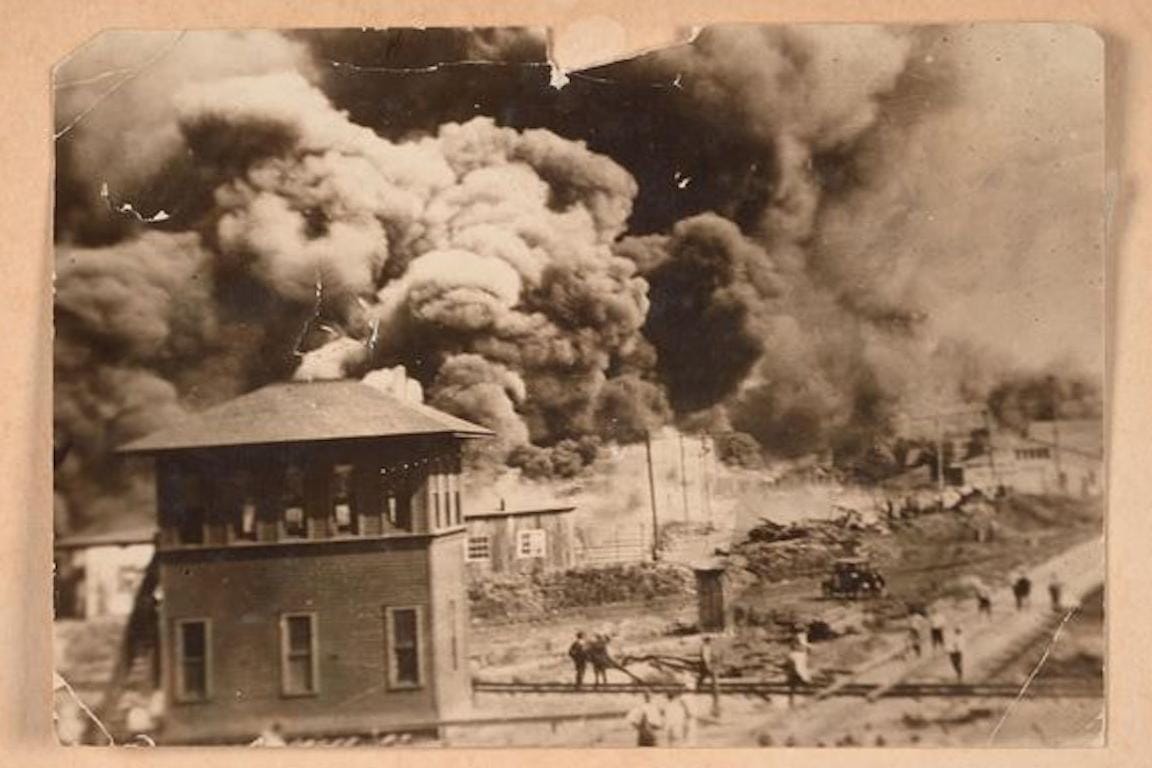
They flew planes over an American city and dropped fire on it. Not in wartime. Not against a foreign enemy. White Tulsa did this to Black Tulsa because Black Tulsa had built something beautiful, and white supremacy couldn't stand it. More people know about this now than a decade ago, but the details still get buried. The scale still gets minimized. So here it is.
Black Wall Street
Greenwood was everything white America said Black people couldn't build. By 1921, this 35-block district in Tulsa housed over 10,000 residents in what had become one of the wealthiest Black communities in the nation. Booker T. Washington called it "Negro Wall Street" - the name stuck, shortened to Black Wall Street. Two newspapers. Multiple churches. A hospital. A library. Hotels, theaters, grocery stores, and restaurants. Lawyers and doctors with thriving practices. O.B. Mann ran Mann Brothers Grocery. There was Williams Dreamland Theatre. Mount Zion Baptist Church. The Stradford Hotel. This wasn't just prosperity - it was defiance made brick and mortar in a viciously segregated America still drunk on lynching and white supremacy.
The Greenwood District existed because of Jim Crow, but it thrived in spite of it. When white Tulsa refused Black dollars, Greenwood built its own economy. When white Tulsa built wealth on oil, some Black Tulsans did too. The Ku Klux Klan claimed 3,200 members in Tulsa by 1921.
And Tulsa wasn't unique. Just two years earlier, the Red Summer of 1919 saw white mobs attack Black communities in more than three dozen cities nationwide - Chicago, Washington D.C., Charleston, Omaha. In Elaine, Arkansas, white mobs massacred hundreds of Black sharecroppers. In Corbin, Kentucky, white terrorists forced the entire Black community of 200 people onto railroad cars at gunpoint. Rosewood, Florida would burn in 1923. East St. Louis had burned in 1917. Wilmington, North Carolina was overthrown by a white supremacist coup in 1898. This was the playbook: Black people build something, white people destroy it. Tulsa was following a well-worn American tradition.
The Match
On May 30, 1921, Dick Rowland, a 19-year-old Black shoe shiner, entered the elevator in the Drexel Building to use the "colored" restroom on the top floor. Sarah Page, a 17-year-old white elevator operator, was working. Something happened - Rowland likely tripped, stepped on her foot, grabbed her arm to steady himself - if anything. She screamed. He ran.
That's it. That's the spark that burned down 35 blocks and killed up to 300 people.
The Tulsa Tribune published an afternoon story on May 31 with the headline "Nab Negro for Attacking Girl in Elevator." Witnesses remembered an editorial in the same edition titled "To Lynch Negro Tonight" - though no complete copy of that day's paper has ever surfaced. Someone made sure of that. By sunset, hundreds of white men gathered outside the county courthouse where Rowland was being held, demanding the sheriff hand him over for lynching.
In Greenwood, residents debated what to do. Many were World War I veterans who'd returned home to a country that still treated them as less than human. Around 25 armed Black men, led by O.B. Mann and Deputy Sheriff J.K. Smitherman, went to the courthouse to help protect Rowland. The sheriff turned them away. They left. As they walked off around 10:30 p.m., someone - accounts differ on who - fired a shot.
All hell broke loose.
The Invasion
What happened next wasn't a riot. The Justice Department would later call it what it was: a coordinated, military-style attack that transcended mob violence.
White Tulsa mobilized for war. The police deputized more than 500 white men in less than 30 minutes - many of whom had just been part of the lynch mob, many of whom were drunk. The city handed badges and weapons to the very people who'd come to commit murder. These deputized forces, along with National Guard troops, organized into martial units. They didn't form a wild mob - they formed an invasion force.
At dawn on June 1, a whistle blew three times. That was the signal.
They came over the Frisco railroad tracks in the thousands - as many as 10,000 white Tulsans, armed with rifles and pistols, many with military training from the recent war. They shot Black men on sight. They chased women and children through the streets. They tied Black people to cars and dragged them. They looted everything - dining room furniture, jewelry, typewriters, even piggy banks. White women filled bags with household goods before white men set homes ablaze.
Dr. A.C. Jackson walked out of his home on North Detroit Avenue with his hands raised. The Mayo brothers had called him one of the finest surgeons in America. His white neighbor, former police commissioner John Oliphant, begged the armed white men not to shoot. "That is Dr. Jackson. Don't hurt him." A man in a white shirt and cap shot him with a high-powered rifle anyway. Shot him twice. Another man shot him through the leg as he fell. Jackson bled to death at Convention Hall. No one was ever charged.
And then there were the airplanes.
Picture this: you're Mary Parrish, reading at home with your daughter Florence on the evening of May 31st. Your nine-year-old calls you to the window. "Mama," she says, "I see men with guns." You flee into the night under gunfire, hide where you can. Morning comes. You think maybe the worst is over.
Then you hear it.
A hum. Getting louder. You look up and see biplanes - more than a dozen of them, circling low over Greenwood. They're not just watching. They're working, methodical, like crop dusters. But what's falling isn't water. It's fire. Turpentine bombs arcing down through the morning air, smashing through rooftops, turning homes into torches from the top down.
Buck Colbert Franklin is in his law office on Greenwood Avenue. He hears the droning engines multiply overhead. The planes circle, dart, dip low enough that he can see the men inside them. Then comes the sound - like hail hammering the roof. Except it's not hail. It's incendiary devices. He watches the old Mid-Way hotel ignite from the top. Then another building. Then another. Roofs collapsing inward, flames eating downward through floors.
You're nine-year-old Mabel McCondichie and your mother is shaking you awake, frantic. "The white people are killing the colored people." You run outside in your nightgown, no time even for shoes, and overhead the planes are circling and bullets are raining down from the sky. You find a chicken coop and hide inside while machine gun fire rips through the air. You're nine years old and planes are shooting at you.
You're five-year-old Essie Beck and your mother is running with you and your four siblings toward Golden Gate Park. Planes overhead, so low you can see the men inside. Your mother makes you stay behind trees because active shooters are targeting windows, targeting streets, targeting anything that moves. Fire rains down from above and houses burst into flame. You're five. You watch this happen. You will remember it for 101 years.
The first aerial attack on an American city. White Tulsa raining fire on Black Tulsa from the sky.
Viola Fletcher, who survived as a seven-year-old child, would testify before Congress 100 years later: "I still see Black men being shot, Black bodies lying in the street. I still smell smoke and see fire. I still see Black businesses being burned. I still hear airplanes flying overhead. I hear the screams. I have lived through the massacre every day."
The Aftermath
By the time it ended on the evening of June 1, Greenwood was ash. More than 1,200 homes destroyed. At least 60 businesses burned. Churches, schools, the hospital, the library - gone. The official death toll was 36. That's a goddamn lie. The Red Cross and NAACP estimated 100-300 dead, most of them Black. Many bodies were buried in mass graves that the city has spent decades trying to find.
Nearly 6,000 Black residents were rounded up and held in internment camps - some for over a week. They could only be released if a white person vouched for them, usually an employer. The phone system was shut down. The railways were blocked. The Red Cross was initially turned away.
Insurance companies refused to pay out claims because they classified the massacre as a "riot." The city passed a fire ordinance requiring all new construction in Greenwood to be built from fireproof materials like brick - materials the newly destitute survivors couldn't afford. It was a land grab dressed up as fire safety.
Buck Colbert Franklin lost his home and his office. He set up shop in a tent with his law partner I.H. Spears - they had law books, a typewriter, and a telephone. From that tent, Franklin fought the fire ordinance all the way to the Oklahoma Supreme Court and won, allowing Greenwood residents to rebuild on their own land. But the damage was done. Many families never recovered. Many left Tulsa entirely. Those who stayed rebuilt Greenwood, but it would never reach the same heights again.
The Silence
Then came the conspiracy of silence.
For decades, Tulsa simply refused to talk about what happened. The massacre was scrubbed from history books, from classrooms, from the city's official record. State archives disappeared. Police documents vanished. Cemetery records were destroyed. The Tulsa Tribune stories were torn from the archived newspapers. As late as 2017, the Tulsa Fire Department published a history from 1897 onward that didn't mention 1921 at all.
Black Tulsans whispered about it. Mary E. Jones Parrish published her eyewitness account, Events of the Tulsa Disaster, in 1923, collecting testimonies from dozens of survivors and creating the most comprehensive contemporary record of the violence. But her book barely circulated and Parrish herself largely disappeared from the record - until her great-granddaughter Anneliese Bruner republished it in 2021 as The Nation Must Awake.
In the early 1970s, journalist Ed Wheeler began researching the massacre after a local editor's suggestion. His article was refused by major publications - he finally published it in a small periodical called Impact. In 1982, Scott Ellsworth, a Tulsa native, published Death in a Promised Land: The Tulsa Race Riot of 1921, the first comprehensive book-length history. Ellsworth spent his college years tracking down survivors and microfilmed newspapers, fighting against a city that desperately wanted the story buried.
John Hope Franklin, the preeminent historian of the 20th century, was six years old when his father Buck Colbert Franklin survived the massacre. John Hope would spend his career documenting Black history that white America wanted erased. In the late 1990s, he and Scott Ellsworth served on the Oklahoma Commission to Study the Tulsa Race Riot, which finally, in 2001, produced an official state report acknowledging what happened.
The commission recommended reparations to survivors and their descendants. Oklahoma passed a symbolic reconciliation act. No reparations were paid.
The Reckoning
The work of historians like Ellsworth and journalists who refused to let the story die slowly chipped away at the silence. The 2001 Commission report made it official state history. Educators pushed to get it into classrooms. In 2020, Oklahoma finally required schools to teach the massacre. The centennial in 2021 brought renewed attention - President Biden became the first sitting president to visit Greenwood. That same year, the Justice Department issued a 126-page report (updated in 2025) calling the massacre exactly what it was: a coordinated attack by as many as 10,000 white Tulsans that "transcended mere mob violence."
Despite all this work, millions of Americans still learned about Tulsa for the first time from TV shows like Watchmen and Lovecraft Country in 2019 and 2020. Plenty more still haven't heard of it at all. That's how thoroughly it was buried - how completely American history textbooks erased it for generations.
As of 2025, two survivors remain alive: Viola Fletcher (111 years old) and Lessie Benningfield Randle (110 years old), who were both children during the massacre. Hughes Van Ellis, Viola's brother, died in October 2023 at age 102. They're still fighting for justice. Their lawsuit for reparations continues. They're still here. Still testifying. Still refusing to let anyone bury this story.
Dick Rowland was released in September 1921 when Sarah Page declined to appear in court and the charges were dismissed. Some survivors claimed the two actually knew each other, that they met up and lived together as a couple in Kansas City afterward. It doesn't matter. The massacre was never about Dick Rowland or Sarah Page. It was about white supremacy seeing Black prosperity and deciding to burn it to the ground.
The people who did this - the thousands who murdered, who looted, who lit the fires, who flew the planes - faced no consequences. None. Not one person was ever convicted for the massacre. That's what justice looks like in America when the victims are Black.
If this seems like ancient history, it shouldn't. State power mobilized against Black and Brown communities. Authorities deputizing civilians to do violence. Victims framed as threats. The types of people who flew planes over Greenwood are pulling children out of beds and zip-tying toddlers in 2025. It's not Tulsa. But it's only a matter of degrees away.
Sources:
Scott Ellsworth, Death in a Promised Land: The Tulsa Race Riot of 1921 (Louisiana State University Press, 1982)
Scott Ellsworth, The Ground Breaking: An American City and Its Search for Justice (Dutton, 2021)
Mary E. Jones Parrish, The Nation Must Awake: My Witness to the Tulsa Race Massacre of 1921, edited by Anneliese M. Bruner (Trinity University Press, 2021; originally published as Events of the Tulsa Disaster, 1923)
Oklahoma Commission to Study the Tulsa Race Riot of 1921, Final Report (2001)
U.S. Department of Justice Civil Rights Division, Report on the Tulsa Race Massacre (2025)
"The 1921 Tulsa Massacre," National Endowment for the Humanities
Tulsa Historical Society and Museum digital archives
"Testimony as Literature," National Museum of African American History and Culture
Survivor testimonies: Viola Fletcher, Lessie Benningfield Randle, Mabel Little McCondichie, Essie Johnson Beck
Buck Colbert Franklin manuscript, "The Tulsa Race Riot and Three of Its Victims" (National Museum of African American History and Culture)