The Wilmington Coup, 1898
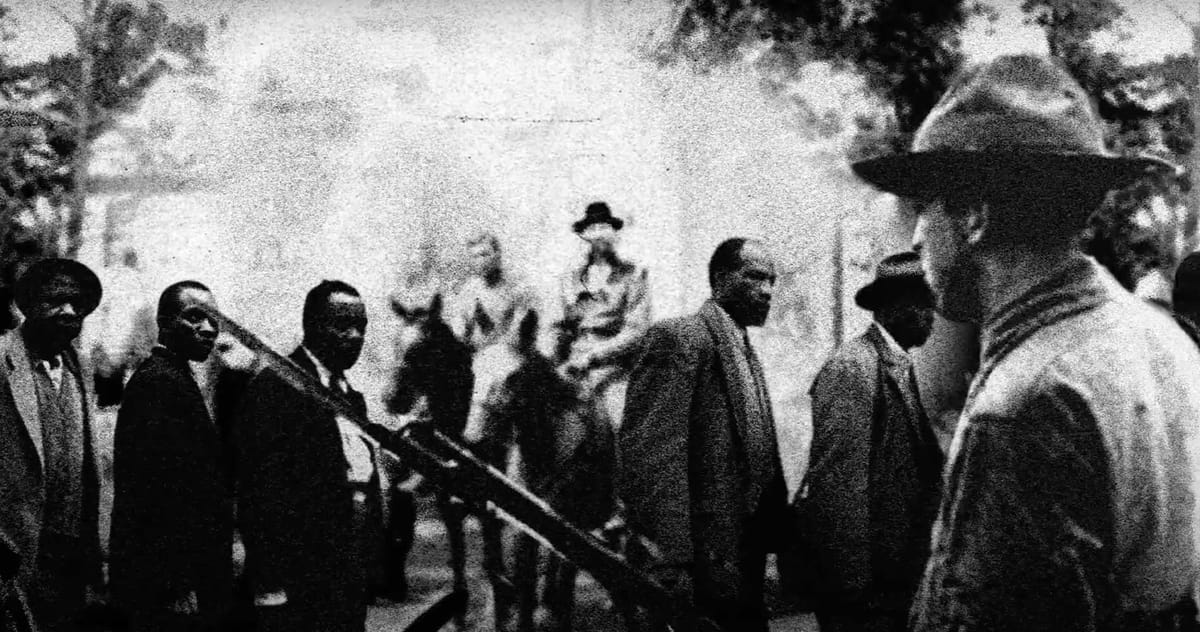
This is the story that started this whole project. The one that made me realize how much of American history has been erased, buried, and whitewashed until we forget what actually happened. Wilmington wasn’t a “riot.” It was a coup, a premeditated violent overthrow of a legitimately elected, multiracial government by white supremacists. And it worked.
It’s what happens when no one stops would-be strong-men and demagogues. It’s the only large-scale coup in U.S. history that succeeded.
So far.
A City of Promise
Wilmington, North Carolina, in 1898 was a rarity in the post-Reconstruction South: a thriving, majority-Black city. Black citizens owned newspapers, barbershops, and grocery stores. They ran schools and sat on the city council. Black and white residents even shared power through a fragile alliance between the Republican and Populist parties.
Black citizens didn’t just vote, they governed. By 1898, Wilmington had a Black police chief, Black aldermen, magistrates, and dozens of Black teachers running the city’s public schools. About 30% of skilled tradesmen were Black. More than 10 Black men held elected or appointed city positions. It was living proof that Reconstruction’s promise hadn’t fully died, and that’s exactly what the white elite couldn’t tolerate.
That success terrified the whites of Wilmington. They couldn’t stand seeing a city where Black men voted, held office, and prospered. So they built a campaign to destroy it - one part politics, three parts terror.
The white-run News & Observer began printing the old familiar lies about “Negro domination” and “the threat to white womanhood.” When Alexander Manly, editor of the Black-owned Daily Record, dared to respond, pointing out that not every interracial relationship was a crime and that white men were often the real predators, it gave the Democrats exactly the pretext they wanted.
This wasn’t new rhetoric. For decades, white politicians and editors had claimed that Black governance was corrupt, ignorant, and dangerous—that white men had a duty to “save” the South from Black rule. Wilmington’s Democrats simply acted on the lie Reconstruction had taught them.
The Coup
It involved an estimated 1,500 to 2,000 armed white men, many from nearby counties, who coordinated with local Democratic leaders, police, and militia units.
This wasn’t a mob. It was an army of white men, organized and armed, moving through the city with military precision. Local Democratic leaders, including Alfred Waddell and Josephus Daniels, plotted the overthrow for weeks. They wrote a “White Declaration of Independence,” promising to end “Negro rule” by force if necessary. They organized armed militias, brought in Gatling guns, and printed leaflets warning Black residents to flee.
On November 10, 1898, the day after an election the white elite refused to accept, they struck. Hundreds of armed white men, many drunk, some wearing militia uniforms, marched into Wilmington’s Black neighborhoods. They torched the Daily Record office, then opened fire on anyone they saw. Families fled through alleys and across the river, chased by gunfire. Witnesses later described bodies in the streets, in doorways, on porches, in the shallows of the Cape Fear River.
No one knows how many were killed. Some historians say 60. Others say closer to 300. The truth was buried with the dead.
By afternoon, Wilmington’s elected officials were rounded up at gunpoint and forced to resign. Alfred Waddell stood before a crowd of armed men and declared himself mayor. The coup was complete before nightfall. By dawn, Wilmington was a white city again.
The People
Many of those killed were identified later in church and community records. Reverend J.H. Howell, a minister at St. Stephen’s AME, was shot while helping neighbors flee. Hannah Carter, a laundress, died protecting her children. Veterans of the 35th U.S. Colored Troops were among the dead, men who had once worn the Union uniform. These were not nameless victims; they were people who helped build Wilmington’s schools, businesses, and churches.
Those murdered in Wilmington had lives, families, and futures. They were business owners, teachers, veterans, people whose only crime was existing in a city that proved multiracial democracy could work. Thomas Miller, a respected grocer, was shot while defending his neighborhood. William Henderson, a father of four, vanished that night and was never seen again. They were only two of many. Entire families were burned out, hundreds driven from the city, their homes looted or seized by white neighbors.
The white men who led the coup were celebrated. Waddell served as mayor for eight years. Josephus Daniels went on to be Secretary of the Navy under Woodrow Wilson. The message was clear: massacre your neighbors, lie about it, no one will stop you.
The Lie
To justify the slaughter, white newspapers called it a “race riot.” They claimed Black residents had “risen up” and that armed white men had restored “order.” It was the same propaganda tactic later used in Tulsa, East St. Louis, and Rosewood. Invent a threat. Stoke fear. Call the massacre self-defense.
The white-owned press across the South, and much of the national press, largely celebrated or ignored the coup. Papers like the Raleigh News & Observer and Charlotte Observer called it a “restoration of good government.” That phrase wasn’t new. It came straight from the Reconstruction playbook: decades of editorials insisting that Black voters were too ignorant to govern and that “order” meant white control. Even northern outlets, including The New York Times, repeated the lie, reporting it as a “race riot.” Only Black newspapers like the Richmond Planet, The New York Age, and The Colored American told the truth, condemning it as mass murder and the violent overthrow of democracy.
Most history textbooks ignored Wilmington entirely or softened it into a story of “racial conflict.” For generations, North Carolinians learned that Wilmington had been saved from chaos. The victims became the villains. The murderers became heroes.
The Story We Carry
Wilmington’s coup destroyed more than lives. It ended an experiment in multiracial democracy that had barely begun. It wiped out a thriving Black middle class, cemented Jim Crow across the South, and taught future demagogues how easily the press and public could be manipulated with moral panic and race fear.
No one stopped them. The federal government did nothing. President McKinley stayed silent. No troops. No prosecutions. No justice.
For nearly a century, the story was erased, rewritten as myth, whispered in families who remembered what really happened, ignored in classrooms that didn’t.
Today, we see the same pattern. When no one stops strong-men and demagogues, they just keep doing whatever they want. Laws, norms, human decency be damned. That’s what forgetting things like Wilmington does - it welcomes more of the same.
Sources
- David Zucchino, Wilmington’s Lie: The Murderous Coup of 1898 and the Rise of White Supremacy, Atlantic Monthly Press, 2020.
- LeRae Umfleet, A Day of Blood: The 1898 Wilmington Race Riot, North Carolina Office of Archives and History, 2009.
- Richmond Planet, November 19, 1898.
- The New York Age, November 17, 1898.
- North Carolina Museum of History: “Wilmington 1898 – A Coup d'État.”