Young Lords' Garbage Offensive, 1969
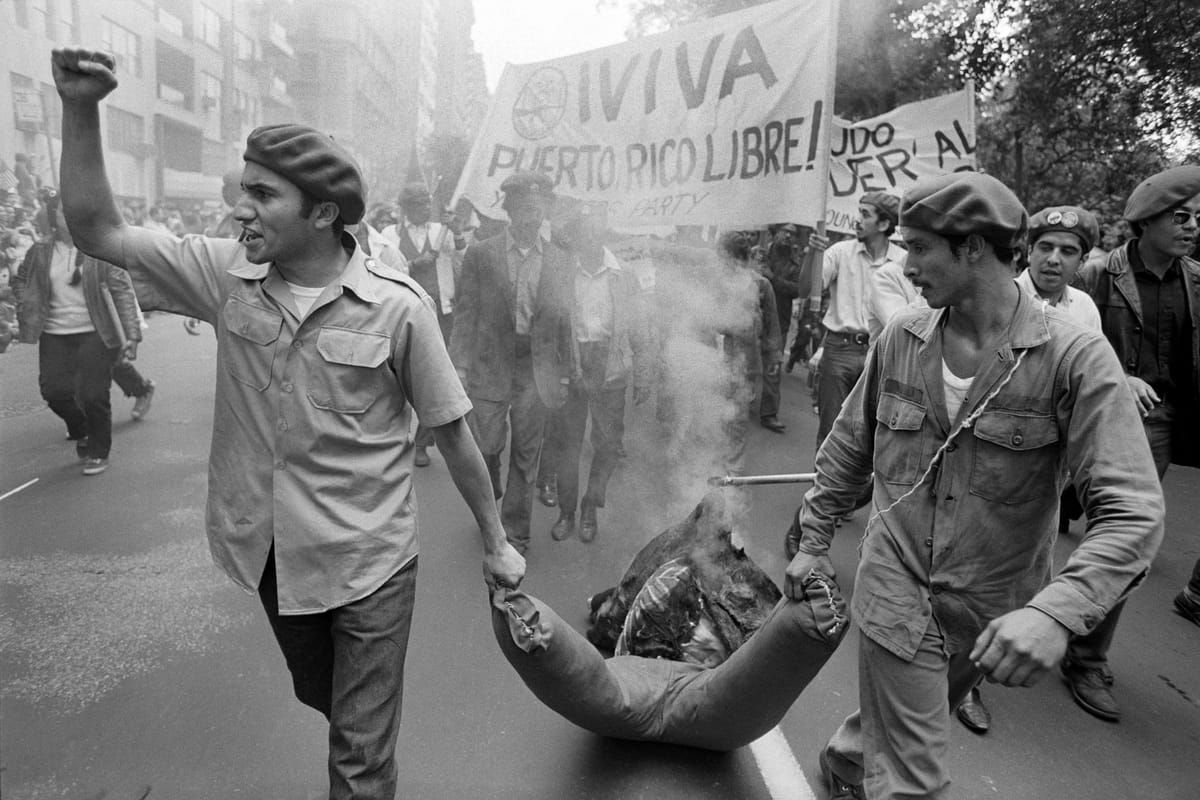
They asked for brooms. The city said no. So they took them anyway.
That act of theft - stealing cleaning supplies from a sanitation depot in East Harlem - kicked off one of the most creative acts of urban resistance in American history. The Young Lords didn't burn down buildings or loot stores. They swept the streets. Then they piled the garbage the city refused to collect into massive barricades across major intersections, lit them on fire, and dared anyone to move them.
This wasn't just about trash. It was about showing a whole city what it meant to treat people like garbage.
The Colony Comes Home
You can't understand East Harlem in 1969 without understanding what the United States did to Puerto Rico. After seizing the island in 1898, the U.S. turned it into an economic experiment. Operation Bootstrap - launched in the late 1940s - promised to modernize Puerto Rico by replacing agriculture with American-owned factories. What it actually did was destroy the island's rural economy, create mass unemployment, and engineer one of the largest forced migrations in U.S. history.
Between 1950 and 1965, nearly half a million Puerto Ricans - about half the island's rural working class - were pushed to the mainland. Most landed in New York City. The government called it economic development. It was colonial extraction with a corporate logo.
These weren't immigrants. They were U.S. citizens fleeing a disaster the U.S. government created. They arrived in cities that needed cheap labor but had no intention of treating them like human beings. In East Harlem, also called El Barrio, Puerto Ricans built a community in a neighborhood the city had abandoned. By 1969, East Harlem was 50 percent more densely populated than other Manhattan neighborhoods, with fewer services, worse schools, and streets drowning in uncollected garbage.
The sanitation department - dominated by a largely Italian American union that residents saw as hostile to communities of color - collected trash sporadically at best. When workers finally showed up, they dumped half the garbage in their trucks and left the rest scattered in the streets. The city's own Daily News confirmed it in March 1969, describing tons of rotting garbage in a 40-square-block zone, 160 streets rarely swept, and only six garbage receptacles for a district that generated mountains of household waste.
This wasn't neglect. It was policy. And it was killing people.
Purple Berets and Stolen Brooms
The Young Lords were a revolutionary Puerto Rican organization that understood something simple: you can't wait for power to give you what you need. You take it. Inspired by the Black Panthers and named after a Chicago street gang that had transformed itself into a political force, five young organizers announced the formation of the New York Young Lords on July 26, 1969, at a rally in Tompkins Square Park commemorating the Cuban Revolution.
Mickey Melendez, Juan Gonzalez, Felipe Luciano, David Perez, and Pablo "Yoruba" Guzman were in their late teens and early twenties. Some were students at City College and Columbia. Some were dropouts. Some were poets and members of the Last Poets. All were done asking politely. They wore purple berets, talked about socialism and Puerto Rican independence, studied Mao and Fanon, and modeled themselves after the Panthers' community survival programs.
But unlike a lot of revolutionary groups who started with theory and worked backwards, the Young Lords started by asking people what they actually needed.
The answer was simple: pick up the goddamn garbage.
So they did. In July, Young Lords members walked into a sanitation depot and asked for brooms. The depot staff refused and met them with hostility. Fine. The Young Lords took the brooms anyway and spent three consecutive Sundays sweeping the streets, piling refuse on sidewalks, and waiting for the city to respond.
No one came. The garbage sat there, rotting in the summer heat.
The Offensive
On July 27, 1969, the Young Lords stopped asking nicely. They called it the Garbage Offensive - named after the Tet Offensive that had shaken Vietnam the year before. The message was clear: this was urban guerrilla warfare, and the enemy was a system that treated Puerto Rican lives as disposable.
They dragged the uncollected garbage into the middle of Third Avenue and 110th Street, along with intersections on First Avenue, Lexington Avenue, and Madison Avenue. Mountains of trash blocked traffic. Eight-year-old kids stood next to the barricades. Mothers who'd been sweeping their own stoops for weeks joined in. When drivers tried to move the piles, the Young Lords set them on fire. Police and fire departments had no choice but to intervene.
The media - tipped off in advance by the Lords' media-savvy Minister of Information, Pablo "Yoruba" Guzmán - showed up to document everything. Guzmán understood something most activists missed: control your own narrative or someone else will. The Young Lords had their own photographers (Hiram Maristany's images would define the era), their own newspaper (Palante), their own radio shows. They didn't just make news - they made sure the story was told right.
The Garbage Offensive escalated throughout August. On August 17, fires erupted across East Harlem. The next day, Luciano outlined the group's demands: daily garbage collection, increased sanitation resources, greater diversity in hiring, higher wages for sanitation workers, and an end to corruption in the department.
It worked. With a contentious mayoral election approaching between incumbent Republican John Lindsay and Democratic challenger Mario Procaccino, dirty streets became a political liability. Lindsay, desperate to salvage his image, sent aides to meet with the Young Lords and implemented systemic sanitation reforms.
The protests ended on September 2, 1969. The Young Lords had forced the largest city in America to blink.
What They Built
The Garbage Offensive wasn't just tactical genius - it was a template. The Young Lords proved you could connect daily problems to systemic oppression, use media to amplify your message, and force powerful institutions to respond. They linked environmental racism to colonialism, showed how cities abandon communities of color, and did it all with brooms and matches.
But they saw something deeper. The same system that let garbage rot in the streets had used Puerto Rican women as guinea pigs for birth control pill testing in the 1950s. By 1969, one-third of Puerto Rican women of childbearing age had been sterilized - often without informed consent, sometimes without even knowing it happened. The Young Lords women, who made up about a third of the organization, understood the connection. Dirty streets and forced sterilization sent the same message: your bodies don't matter, your neighborhoods don't matter, your lives don't matter.
These women - Denise Oliver-Vélez, Iris Morales, Gloria Fontanez, and others - would soon fight a second revolution inside the first one. Within a year, they'd force the Young Lords to strike "Machismo must be revolutionary" from their platform and replace it with "Down with machismo and male chauvinism." They'd get women onto the Central Committee. They'd create one of the first comprehensive reproductive justice platforms in the country. But that fight was still ahead. In the summer of 1969, they were in the streets with everyone else, building barricades and lighting fires.
They didn't stop with garbage. Over the next three years, the Young Lords commandeered an x-ray truck to test for tuberculosis, occupied Lincoln Hospital to demand better healthcare, took over the First Spanish Methodist Church to provide free breakfast programs and community services, and launched campaigns against lead poisoning. They published a newspaper called Palante, ran free breakfast programs with the Black Panthers, and built what became known as the Rainbow Coalition - an alliance of the Young Lords, the Black Panthers, and the Young Patriots (poor white Appalachians organizing in Chicago). About 25 percent of the Young Lords' membership was Black. This wasn't identity politics - it was class war across racial lines.
But the movement was short-lived. By 1972, internal conflicts, government infiltration, and ideological splits tore the organization apart. Felipe Luciano was ousted from leadership in 1970. The underground military wing disbanded. The party collapsed.
Many of the Young Lords went on to prominent careers. Juan Gonzalez became a celebrated journalist and co-host of Democracy Now! Pablo Guzman became a pioneering Latino television reporter. Felipe Luciano became an Emmy-winning news anchor and poet. Mickey Melendez continued organizing and wrote a memoir about the movement.
The reforms they won? Some stuck. Many were quietly reversed once the cameras left. That's how power works - it gives just enough to stop the fire, then takes it back when no one's watching.
The Pattern
Here's what the Young Lords understood that most people miss: environmental racism isn't separate from other forms of oppression. It's the same system. When cities let garbage pile up in Black and brown neighborhoods, when they underfund schools and hospitals, when they militarize police and abandon infrastructure, it's all connected. It's all about who gets treated like human beings and who gets treated like trash.
The Garbage Offensive was one of the first environmental justice campaigns in American history, decades before the term existed. The Young Lords saw that dirty streets weren't just an inconvenience - they were a public health crisis, a symbol of systemic abandonment, and evidence of a city that viewed Puerto Rican lives as disposable.
Fifty years later, the same neighborhoods still face the same problems. Environmental hazards still cluster in communities of color. Sanitation services still vary by zip code. The powerful still ignore the powerless until someone lights a fire they can't put out.
The Young Lords showed us how to fight back. Not with speeches or petitions, but with direct action that makes the problem impossible to ignore. They took the city's neglect and shoved it right back in its face, literally blocking traffic with the evidence of its crimes.
That's the lesson. That's what they'd rather you forget. That when systems fail you, sometimes the answer is simple: take the brooms, sweep the streets, and set the garbage on fire until someone pays attention.
Sources
- Johanna Fernández, The Young Lords: A Radical History, University of North Carolina Press, 2020.
- Mickey Melendez, We Took the Streets: Fighting for Latino Rights with the Young Lords, St. Martin's Press, 2003.
- Iris Morales, Through the Eyes of Rebel Women: The Young Lords, 1969-1976, Red Sugarcane Press, 2016.
- "When the Young Lords Put Garbage on Display to Demand Change," History.com, May 28, 2025.
- "Garbage Offensive," Wikipedia, September 2025.
- "The Young Lords' Radical Fight for Environmental Justice," Edge Effects, July 29, 2021.
- New York Daily News special series on East Harlem blight, March 1969.
- Museum of the City of New York, "Young Lords" exhibition materials.
- Erik Wallenberg, "Environmental Justice Organizing and the Young Lords."
- Young Lords Party, "Position Paper on Women," Palante, 1970.